The British colonial administration in the Malvina Islands formalized its economic and institutional consolidation plan for the next five years. Through the official document titled “Islands Plan 2026-2030 , ” adopted by the local Executive Council on October 27 and signed by the eight members of the colonial Legislative Assembly (Stacy Bragger, Lewis Clifton, Dean Dent, Jack Ford, Michael Goss, Dot Gould, Cheryl Roberts, and Roger Spink), the enclave unveiled a program of direct capital investments exceeding USD 390 million (more than £300 million).
The core of the initiative rests on two strategic pillars: the execution of heavy infrastructure works —with the construction of a new commercial and service port at the forefront— and the creation of a " Sovereign Wealth Fund " designed to hold the royalties and taxes from oil exploitation in the North Malvinas Basin, whose development is led by the consortium of the Israeli Navitas Petroleum and the British Rockhopper Exploration through the Sea Lion field.
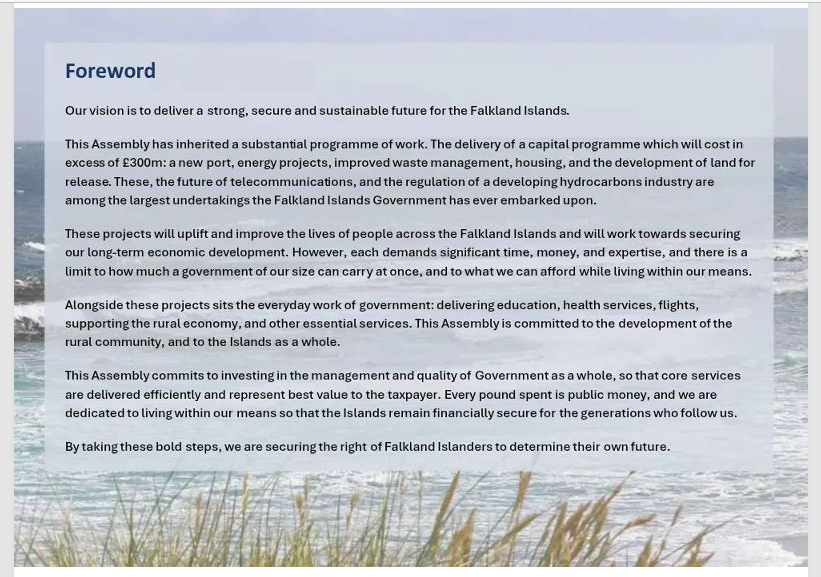
The document contains no mention whatsoever of the Argentine Republic, to whose territory the archipelago and its surrounding continental shelf belong. On the contrary, the plan's back cover encapsulates the project's ideological foundation with a bronze reproduction of a direct quote from Margaret Thatcher, delivered in the House of Commons on April 3, 1982 : “ They are few in number, but they have the right to live in peace, to choose their own way of life and to determine their own loyalties.”
Forty-four years of passivity: the construction of the economic loot
The presentation of the four-year plan exposes a strategic defeat that Argentine diplomacy avoided confronting rigorously for more than four decades. After the cessation of hostilities in June 1982, successive Argentine administrations—except for periods of rhetorical confrontation or last-minute legal injunctions—neglected the process by which London transformed a precarious military occupation into an ultra-profitable financial and extractive empire.
Before the war, the islands were a cattle-ranching territory with just over 1,800 inhabitants, financially dependent on the British Treasury. The lack of effective action after the 1982 war also marked that diplomatic defeat that has persisted for 44 years.
Key projects: megaport, telecommunications and immigration security
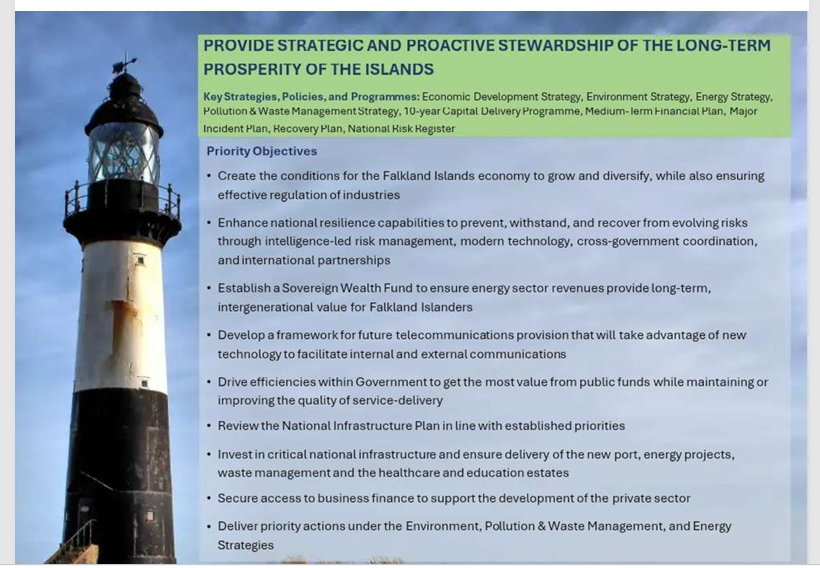
The text of the Islands Plan details the material objectives that the colony plans to erect before the end of the decade:
The Argentine crossroads: from rhetoric to the audience in Germany
The launch of the colonial plan comes at a time of heightened procedural tension between the two countries. Just ten days separate the national diplomacy from the hearings on November 10 and 11 before the International Tribunal for the Law of the Sea (ITLOS) in Hamburg, where Ambassador Mario Oyarzábal will attempt to obtain an injunction to halt the drilling operations by Navitas and Rockhopper.
The contradiction between the two models is stark: while the occupying administration plans to spend hundreds of millions of dollars to manage the wealth of a foreign platform, the Argentine State is scrambling to deal with faits accomplis with cases that should have been opened decades ago.
Added to this are the inconsistencies of Javier Milei's administration, who, while filing lawsuits in Germany or environmental injunctions in Rio Grande, sends missions to London to seek mining investments and yields to pressure from Washington to ease sanctions on firms complicit in the occupation.
The colonial government's document confirms what Argentine politics has chosen to ignore : British colonialism in the South Atlantic is not an abstract slogan, but an extractive corporation that plans for the long term. Every dollar poured into the islands' sovereign wealth fund will come from a barrel of non-renewable hydrocarbons that the Argentine people lose forever beneath the seabed of their own land.

Tags
Other news about Malvinas
Princess Anne lands in the Malvina Islands at the same time as the trial at the International Tribunal for the Law of the Sea.
The British colony in the Malvina Islands blocks access to information due to the “economic war” with Argentina.
Fisheries enforcement: the colonial bureaucracy that guards the business of the sea in the South Atlantic