
Intense activity over the waters of the Drake Passage and the Antarctic Peninsula marked the formal start of the 2026/2027 Antarctic season in the fields of science, polar logistics, and expeditions . Through Flightradar24 radar tracking, Agenda Malvinas documented the simultaneous operation of at least six medium-sized polar aircraft transiting south, all taking off or landing at the runway of Presidente Carlos Ibáñez del Campo International Airport in Punta Arenas, Chile.
The synchronized movement reflects the extensive transcontinental flights these machines completed in the preceding weeks. Coming from northern latitudes—after traversing the Americas from north to south and, in the case of the British units, crossing the Arctic and the Atlantic—the crews waited for favorable weather windows at the southern tip of the South American continent to begin their crossing to the Antarctic ice floes.
X-ray of the six aircraft detected
Tracking license plates and specific models made it possible to identify the three main operational pillars of the deployment : support for government polar programs, geophysical prospecting, and specialized commercial/tourist logistics.
1. VP-FBQ (De Havilland Canada Dash 7 – British Antarctic Survey): The flagship four-engine aircraft of the British Antarctic Survey (BAS). Based primarily in Rothera , it serves as the main transport link for passengers and scientific cargo between South America and the British base, as well as connecting with runways in the Malvina Islands during the summer campaign.
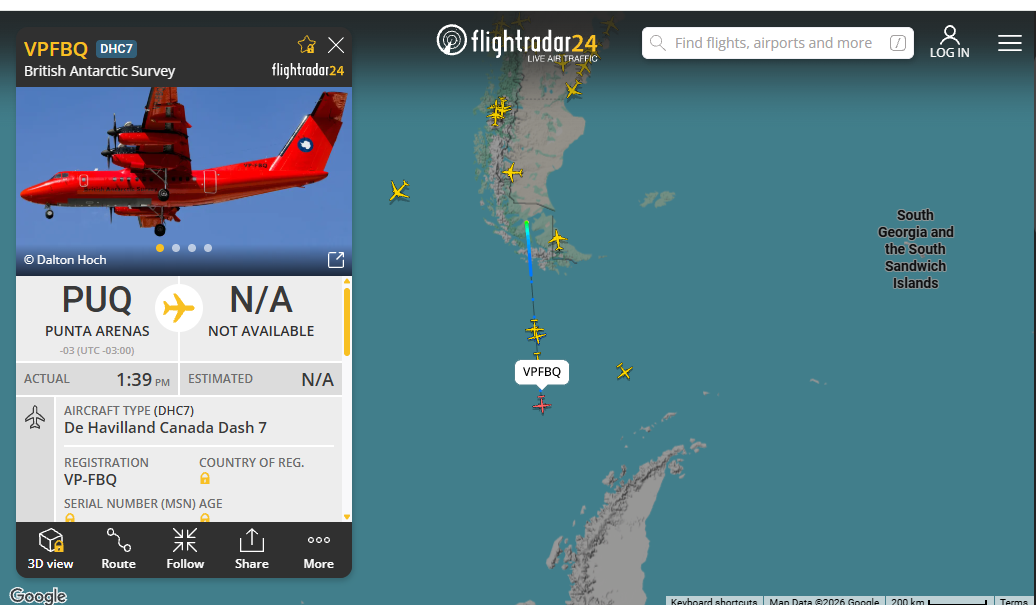
2. VP-FBC (DHC-6-300 Twin Otter – British Antarctic Survey): Twin-engine aircraft equipped with snow and ice skis, a fundamental part of the BAS in the intra-Antarctic link, transport of field camps and support for British glaciological research.
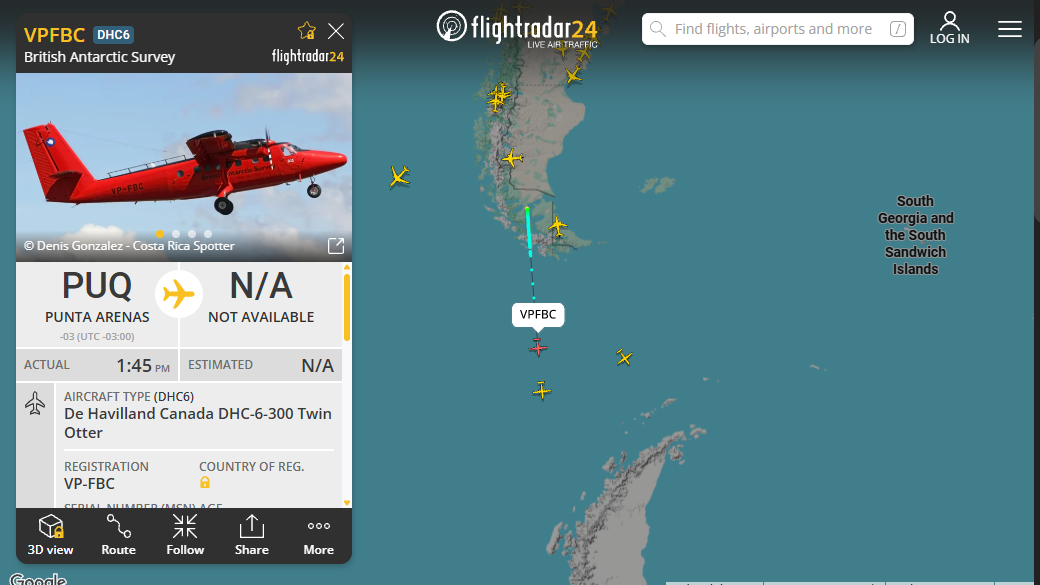
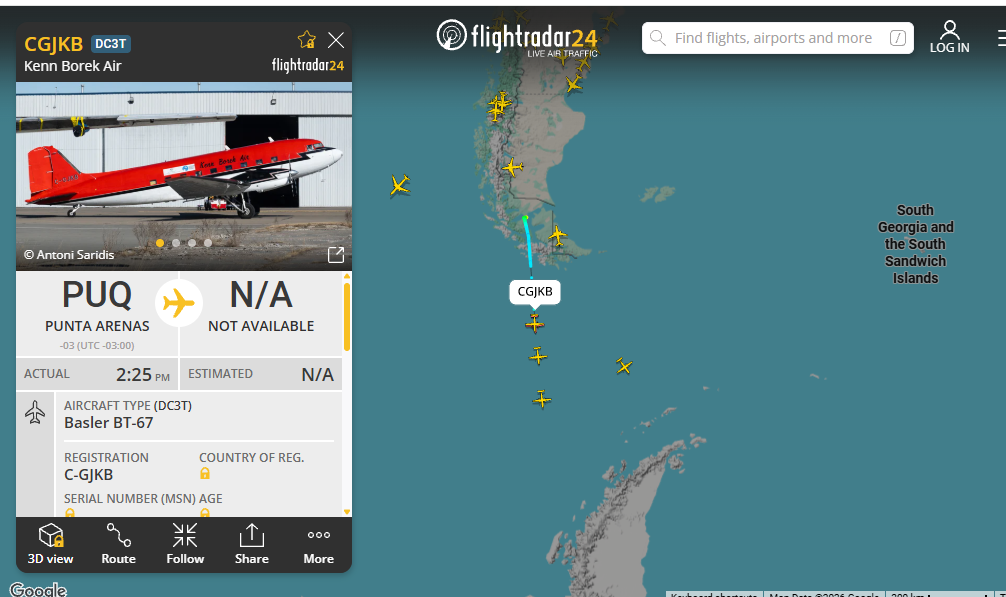
3. C-GJKB (Basler BT-67 – Kenn Borek Air): The Canadian firm Kenn Borek Air , an undisputed global leader in extreme polar aviation, operates these legendary Douglas DC-3s modernized with Pratt & Whitney turboprop engines. It is chartered annually by various national polar programs and expedition companies (such as Antarctic Logistics & Expeditions - ALE) to supply deep-sea camps on the continent.
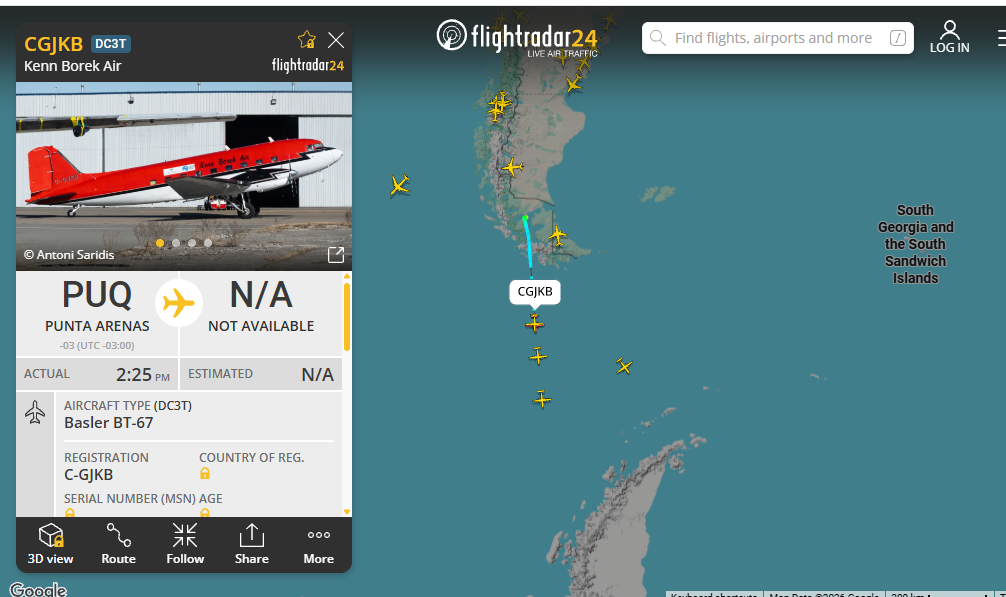
4. C-GGSU (Basler BT-67 – CGG Aviation): Aircraft configured with electromagnetic and magnetometric sensors and instruments. Its presence is for geophysical prospecting, geological mapping, and high-precision aerial measurements of the Antarctic ice mass and crust.
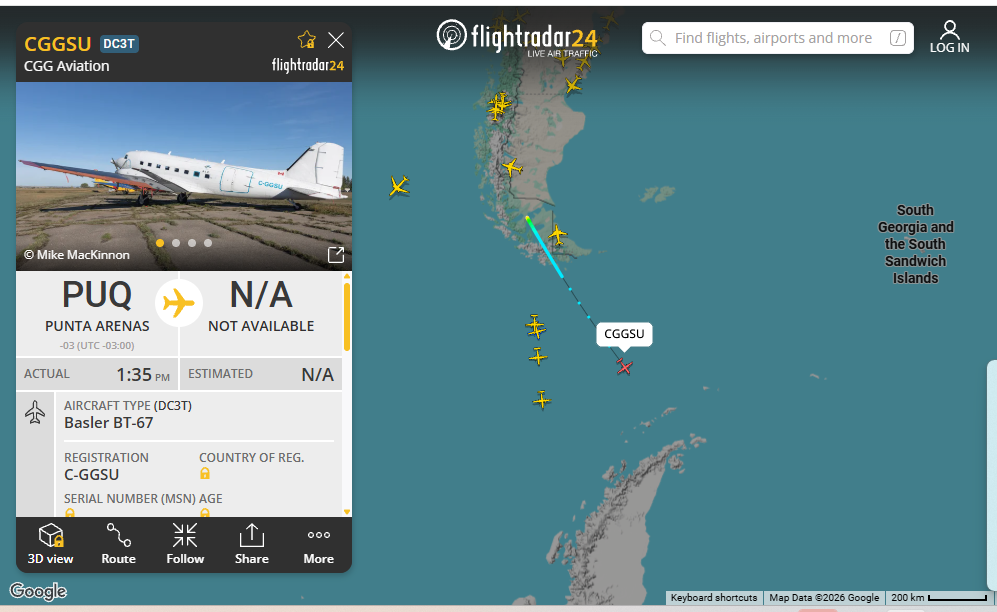
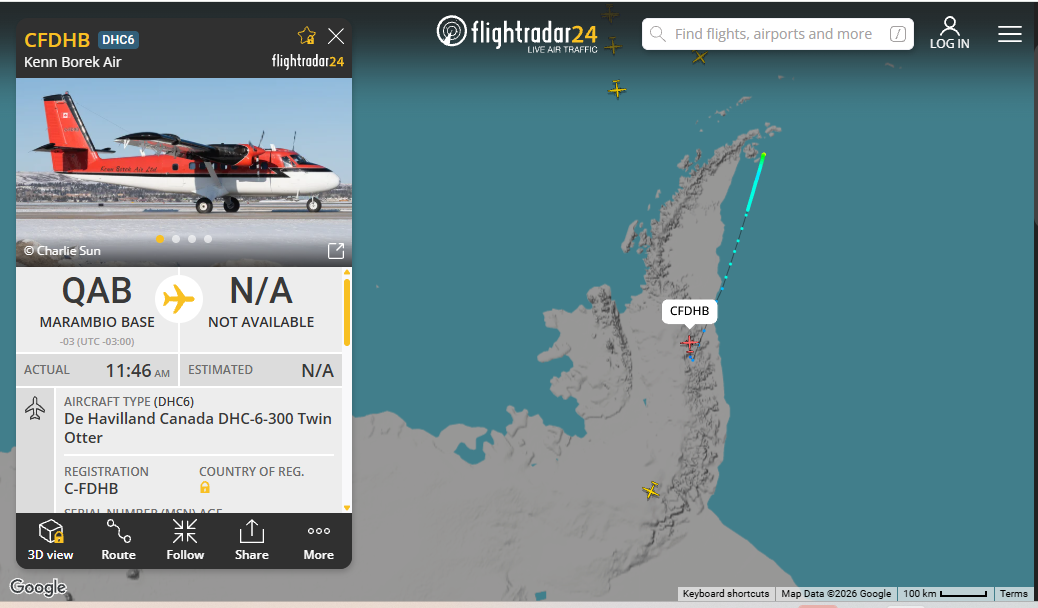
5. C-FDHB (DHC-6-300 Twin Otter – Kenn Borek Air): Another specialized twin-engine aircraft from the Canadian contractor. The tracking record confirms its advanced trajectory descending along the axis of the Antarctic Peninsula after passing the South Shetland Islands archipelago, carrying out tactical liaison and insertion tasks at summer camps.
6. C-GVKB (Basler BT-67 – Kenn Borek Air): The third unit in Kenn Borek's logistics pool detected traveling deep into the southern part of the peninsula. Its cargo capacity and range make it the workhorse for commercial logistics support, transporting expeditions, and supplying international scientific stations.
The consolidation of Punta Arenas in the face of Argentina's lag
Beyond the technical value of the operations, the image of a swarm of polar aircraft continuously taking off from Punta Arenas reveals an undeniable geopolitical and logistical reality.
The Magallanes terminal at Ibáñez del Campo continues to solidify its position as the main air hub for Antarctica, serving scientific programs in the Northern Hemisphere, British activity in the sector (which it competes for with Chile), and the multi-billion dollar Antarctic tourism and expedition industry. Chile has successfully established efficient ramp services, exemptions, Antarctic fuel storage capacity, and technical accommodations adapted to the requirements of major international operators.
Meanwhile, Argentina—through Ushuaia, and to a lesser extent Río Gallegos—maintains almost exclusive dominance in cruise tourism, but continues to lag behind in attracting Antarctic logistics and air traffic. Projects aimed at transforming Tierra del Fuego into a true integrated intermodal logistics hub have, for the most part, remained mere declarations and empty rhetoric, leaving the infrastructure and operational dynamism to remain concentrated on the Chilean side of the Andes.
Tags
Other news about Antarctica
The icebreaker Irízar set sail from Ushuaia for the final stage of the Antarctic Campaign
Chile strengthens its presence in Antarctica while Argentina retreats
122 years of Argentine Antarctica: Between the sovereign milestone of Fuegian logistics and the threat of the Southern Command


