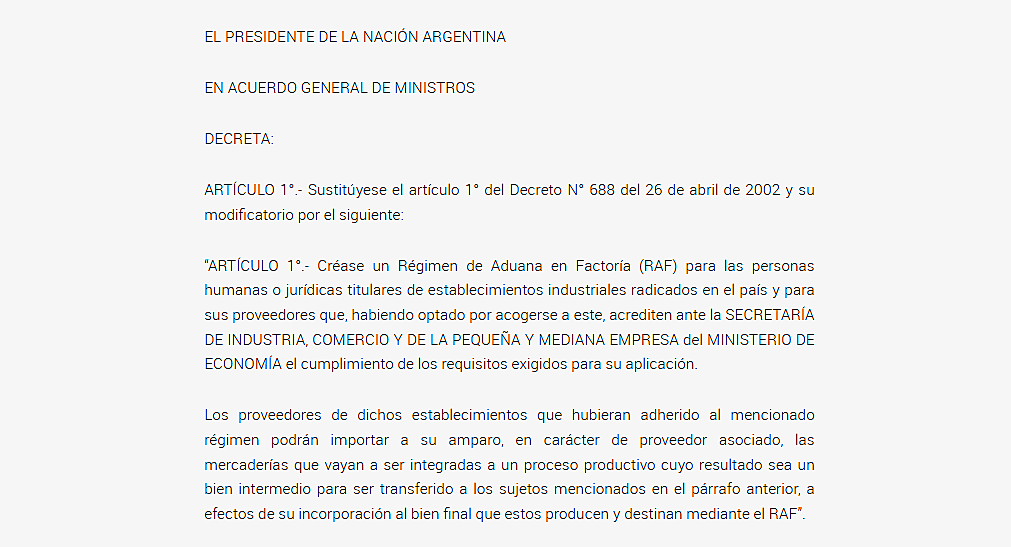
El escenario industrial de Tierra del Fuego y la permanencia de argentinos y argentinas en la provincia marítima y bicontinental de la Nación, ingresa en el peor escenario desde su creación en 1972. Y es que través del Decreto 252/2026 que entrará en vigencia el 17 junio venidero; el Gobierno del presidente Javier Milei oficializó la extensión del Régimen de Aduana en Factoría (RAF) a todos los sectores productivos del país. Una herramienta que hasta ahora es, en la práctica; el diferencial competitivo de la provincia más austral, en similitud estratégica a la de Manaos en el norte de Brasil.
¿Qué es el RAF y por qué altera el tablero fueguino?
El Régimen de Aduana en Factoría es un mecanismo aduanero que permite a las empresas importar insumos, partes y componentes sin pagar derechos de importación ni impuestos internos, siempre que estos se utilicen en un proceso industrial.
Este beneficio es la piedra angular de la Ley 19.640. Al ser Tierra del Fuego un área aduanera especial, sus fábricas pueden ingresar tecnología e insumos del exterior sin aranceles, permitiéndoles competir con los productos importados que llegan a los grandes centros de consumo. El nuevo decreto nacional amplia este beneficio al continente: ahora, cualquier planta en el centro o norte del país podrá operar bajo esta modalidad.
Las consecuencias inmediatas: El desincentivo territorial
La medida genera un efecto de "igualación hacia abajo". Al permitir que una empresa en el área nacional continental acceda a insumos sin aranceles y difiera el pago de impuestos hasta la venta del producto terminado, se eliminan las razones económicas para producir en una zona de alta complejidad logística y climática en las ciudades australes de Río Grande y Ushuaia.
En términos operativos, esto se traduce en:
- Pérdida de competitividad relativa: La provincia de Tierra del Fuego ya no ofrecerá una ventaja que justifique los mayores costos de fletes y salarios australes.
- Riesgo de desinversión: Las empresas con plantas en el continente y en la Isla Grande, concentraran sus procesos allí donde la logística sea más económica.
- Impacto en el empleo: Sin el diferencial arancelario, el sostenimiento de los 200.000 habitantes que hoy dan vida a la provincia se vuelve una incógnita en términos económicos, financieros y sociales.
Mirgor y la "mesa chica" de la diversificación
Qué casualidad que este cambio normativo nacional se produce en un momento donde los principales actores del sector ya han comenzado a mover sus piezas fuera de la jurisdicción fueguina.
El Grupo Mirgor, propiedad de Nicolás Caputo, uno de los mayores beneficiarios del régimen austral, y primo del actual ministro de Economía del Luis “Toto” Caputo, ha consolidado una estructura ejecutiva diseñada para la expansión regional y continental, y no de la Tierra del Fuego que la convirtió en importante un grupo empresario internacional.
Bajo la dirección de José Luis Alonso (CEO), la compañía ha proyectado inversiones superiores a los 400 millones de dólares, pero con un centro de gravedad que se desplaza: la construcción de la planta ONTEC en Baradero es el ejemplo más claro de esta nueva etapa.
La ejecución de esta estrategia de vaciamiento de la Tierra del Fuego, no es anónima; tiene nombres y apellidos:
- José María Gil Bueno (VP de Tecnología) y Eduardo Koroch (VP de Producción) coordinan la migración de procesos hacia nuevos polos.
- María Eugenia Starowicz (VP de Supply Chain) gestiona una red de hubs que incluye Uruguay, Paraguay y Miami.
- María de las Mercedes Rotondó (VP de Nuevos Negocios) lidera la búsqueda de oportunidades que ya no tienen a Tierra del Fuego como eje central.
El interrogante de fondo
Si la Ley 19.640 fue dictada para garantizar el poblamiento y la permanencia de argentinos en un territorio geopolíticamente sensible, el Decreto 252/2026 actúa efectivamente en sentido contrario. Al licuar los beneficios que hacen viable la vida industrial en el Sur, el Estado Nacional retira el incentivo para que el capital —y la gente— logren el arraigo necesario en altamente estratégica de la República.
Evidentemente que este gobierno nacional viene a destruir todo aquello que involucre la defensa de la soberanía. Porque sin fábricas no hay trabajadores; sin trabajadores no hay pueblo; y sin el pueblo en Tierra del Fuego, el reclamo por Malvinas y la Antártida se convierte en una consigna vacía de contenido territorial.
Tags
Otras noticias de Nacionales
El cronograma argentino para la entrega del control del Atlántico Sur a los EE.UU.
El Ministerio de Economía de la Nación publica mapas denominando "Falkland" a las Islas Malvinas
EL SENADO AVANZA CON UNA LEY PARA PERMITIR LA ENTREGA DE TIERRAS A ESTADOS EXTRANJEROS