
The foreign policy of Javier Milei's administration definitively shattered any attempt to maintain a double standard regarding the Malvina Islands issue this Thursday . Within the Fourth Committee (Special Policy and Decolonization) of the United Nations General Assembly, the Argentine delegation chose to abstain from voting on a resolution that ratified and strengthened the historic Resolution 1514 (XV) against all contemporary forms and manifestations of colonialism.
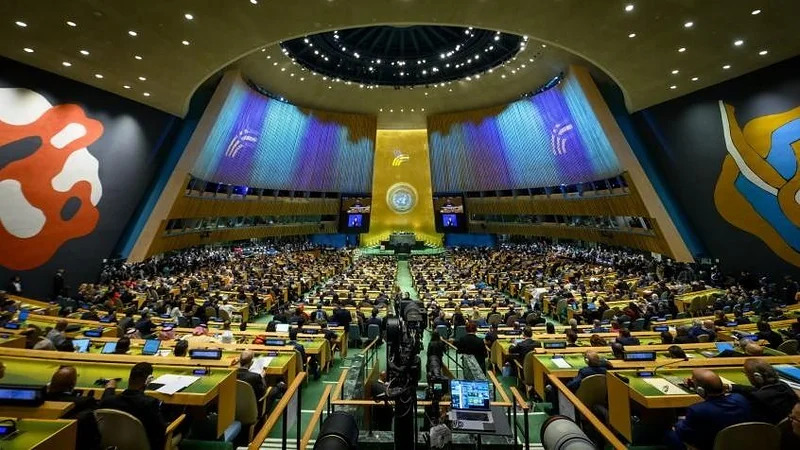
The automatic alignment with the United States' foreign agenda not only relegated the country to the role of mere caboose of the northern hemisphere, but also directly violated the most solid legal and multilateral pillar that supports Argentina's position on the southern archipelago usurped by the United Kingdom since 1833.
Keystone of the Argentine claim
To understand the gravity of the situation, it is necessary to recall that Resolution 1514 —adopted in 1960 and known as the Declaration on the Granting of Independence to Colonial Countries and Peoples —enshrines in its sixth paragraph the principle of territorial integrity: no attempt aimed at the partial or total disruption of the national unity and territorial integrity of a country is compatible with the purposes and principles of the UN Charter . On this unshakeable foundation was built the landmark Resolution 2065 (XX) of 1965, which recognizes the sovereignty dispute and dismantles the British claim to invoke “self-determination” for an implanted population.
The project voted on this Thursday sought precisely to strengthen the tools against “ modern and contemporary forms of colonial domination,” achieving resounding approval with 85 votes in favor, 49 against, and 23 abstentions . While nations of the Global South with which the country has traditionally shared the trenches of decolonization—such as Brazil, Mexico, South Africa, and India—voted consistently in favor of the resolution, the Argentine Foreign Ministry chose to abstain, joining a small group uncritically aligned with the White House.
From staged speeches to actual surrender
The UN decision exposes the emptiness of official gestures. Just weeks after the president himself offered perfunctory words against colonialism in New York, reminding everyone that self-determination "cannot enshrine situations born of colonization," his own diplomacy acted in a diametrically opposed direction. The charade of "sovereign defense" and the administrative threats against British oil companies in Tierra del Fuego waters collapse under their own weight when the State refuses to condemn colonialism in the forums where the legal and political battle against the invader is being waged.
The underlying justification that led Washington to reject the initiative—originally promoted during this period by the Russian Federation—lay in the desire to avoid challenges to coercive economic measures and sanctions. However, for the Argentine Republic, subordinating an inalienable principle of decolonization to external geopolitical interests represents a flagrant act of strategic irresponsibility and a transgression of the express mandate of the First Transitory Provision of the National Constitution.
Tags
Other news about International
The regional and European double game: diplomatically supporting Argentina while maintaining the British enclave in the Malvinas
Galician fishing companies operating in the Malvina Islands urgently delete their corporate records
Britain appointed Vaughan Lowe as ad hoc judge to confront Argentina at the International Tribunal for the Law of the Sea.


