
The struggle between Argentina and the United Kingdom over control of the North Malvina Basin has received a significant diplomatic and corporate response from Great Britain. In a statement released yesterday, the islands' colonial government officially extended all offshore hydrocarbon production licenses for an initial period of five years, extendable by an additional two years at the discretion of the assembly, reaffirming the "full support of the UK Government."
The move is driven by a timing factor: the concession for block PL001 , which was set to expire on December 31. With the signing of this extension, the colonial authorities guarantee the validity of the permits until the end of 2031 (or 2033), conditioning the extension on "satisfactory progress" that will require the operators to commit to drilling additional appraisal wells. Among the companies affected are Rockhopper Exploration —along with its subsidiaries Malvina Oil & Gas and Desire Petroleum—and Navitas Petroleum Development and Production .
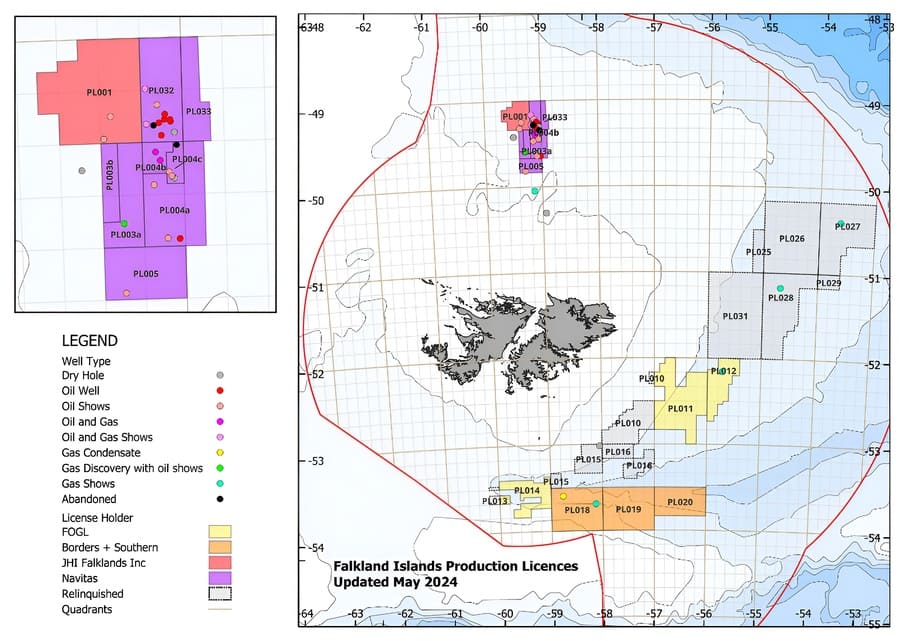
Meanwhile, the Malvina Islands government approved Navitas Petroleum Atlantic Limited's acquisition of 65% of the PL001 area , a transaction agreed upon in February and formalized on March 2 with the Canadian company JHI Associates Inc. , which retains the remaining 35% through its subsidiary JHI Malvina . The block covers approximately 1,126 square kilometers at a depth of 500 meters and directly borders the PL032 license, the heart of the Sea Lion field, to the east. According to JHI's corporate estimates, the entire field holds 3.1 billion gross barrels of oil, with key areas such as Tyche and Dinlas estimated to contain around 400 million recoverable barrels each.
Colonial Assemblymember Cheryl Roberts , responsible for Mineral Resources , argued that the extensions “provide security for operators, allowing them to continue investing” and challenged: “These are our resources to develop and we will ensure they are developed responsibly.”
The British resolution emerges as an attempt to shield itself from the escalating Argentine institutional crisis: it comes six days after the trade guide issued by the Foreign Office, three days after the British Minister for Overseas Territories, Uma Kumaran, labeled the Argentine Foreign Ministry's claims "unacceptable," and in direct response to the precautionary measure of the federal judge of Rio Grande, Mariel Borruto, who ordered the material suspension of Sea Lion's work until the national environmental authority intervenes.
London is also seeking to mitigate the impact of the National Sovereignty Defense Bill submitted to the Argentine Congress by Javier Milei, which includes penalties of up to 20 years in prison, trials in absentia, and fines valued in barrels of WTI crude. While Argentina maintains 60 administrative investigations and three criminal complaints in Comodoro Py for violations of Law 26,659, Great Britain is defying UN Resolution 31/49 by intensifying its illegitimate concession of sovereign resources on the Southern Continental Shelf.
Tags
Other news about Malvinas
As long as Argentina allows Uruguay to supply the Malvina Islands, it has no moral authority to prevent Chile from doing so.
The end of “self-determination”: Great Britain takes control of oil licenses in the Malvina Islands
The Malvina Islanders want to ban Argentinians from entering the Malvina Islands.


