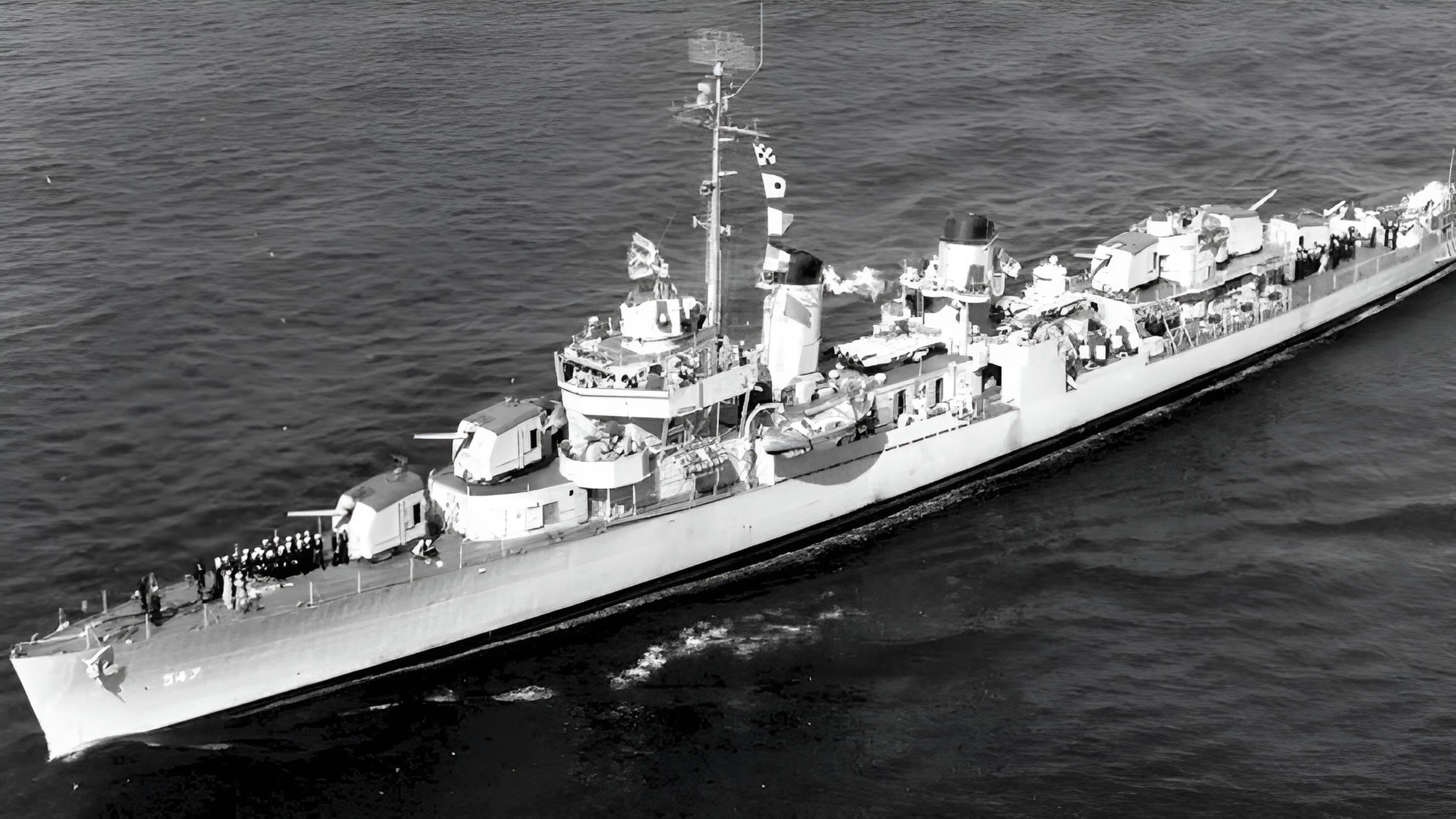
The destroyer Alte Storni. The Argentine warship that on February 4, 1976, chased the scientific vessel RRS Shackleton, which was illegally conducting studies on the Argentine continental shelf.
For many, the relationship between the 1976 coup and the 1982 Malvinas War is merely chronological. However, historical research and declassified documents reveal a far more sinister truth: March 24th was the day national defense was deactivated, paving the way for a business plan that used the blood of Argentinians as currency .
I. The RRS Shackleton Incident
In late 1975, Britain launched an act of scientific piracy. They sent the RRS Shackleton to map what Lord Shackleton called the "economic future" of the islands. The British report revealed the following: the Malvinas were unviable as a sheep colony, but could become a power if they managed to capture the fishing grounds and extract oil from the seabed.
After diplomatic warnings that Great Britain ignored, the constitutional government of María Estela Martínez de Perón implemented the "Doctrine of Material Response." On February 4, 1976, the destroyer ARA Almirante Storni , under the command of Commander Ramón Arosa , intercepted the Shackleton 78 miles from Puerto Argentino. Faced with the British refusal to stop, the Storni fired warning shots with its 127mm cannons , which landed within meters of the British bow.
Simultaneously, he cut YPF fuel supplies and LADE flights, in effect since 1972 through cooperation and assistance agreements between Argentina and the United Kingdom.
Foreign Minister Raúl Quijano effectively expelled British Ambassador Derek Ashe . And by the week of March 24, the government was going to send to the National Congress the approval for the formal severing of relations with the usurping power.
On March 24, 1976, he "saved" London . Videla's dictatorship, desperate for international recognition, immediately restored relations and defused diplomatic pressure. The British went from alarm to relief: the enemy of their economic plan was no longer in the Casa Rosada, but being persecuted in the streets of Argentina.
II. The Financial Plot: The Malvinas as debt collateral and the City's "Insurance"
José Alfredo Martínez de Hoz 's economic model was not an isolated policy; it was a system of dependency that absolutely required London's approval. While a systematic plan of forced disappearances was being implemented on the continent to discipline the working class and dismantle national industry, the loans that kept the regime afloat were being signed in the offices of British banks.
1. The Faces of the British Connection : Executives of Lloyds Bank International , such as William de Gonneville Lowndes , and the bank's president in London, Sir Jeremy Morse , were the architects of the flow of foreign currency. They were not passive observers: they secured syndicated loans that allowed the dictatorship to sustain repressive spending and the fiction of "easy money." Argentina's external debt, which in March 1976 stood at $7.8 billion, skyrocketed to $45 billion by 1982.
2. The Bought Silence : Declassified cables from the British ambassador in Buenos Aires, Anthony Williams , reveal the cynicism of the era. Williams informed London that the Videla regime was committing atrocities, but explicitly recommended "not pressing on human rights." The reason? Great Britain didn't want to risk lucrative arms sales contracts (such as the Type 42 destroyers that would later be used in the war), nor upset a military junta that punctually paid its debt interest to British banks.
3. The Master Scam of 1982 : The Nationalization of Private Debt. The final act of this economic betrayal occurred in July 1982, just weeks after the surrender in Puerto Argentino. While Argentine families mourned their dead, the Central Bank (under the management of Domingo Cavallo and with the approval of the Junta) issued Circular A-251 .
Through this " exchange rate insurance" mechanism, the dictatorship transferred the dollar-denominated debts of large private companies into the pockets of all Argentinians. The economic groups that had instigated the 1976 coup—many of them linked to British capital or the diversified oligarchy—were left financially unscathed, while the national government assumed an unpayable debt.
4. The Criminal Paradox : This maneuver reveals a chilling truth: Argentina guaranteed the collection of private debts to the enemy country's banks while its soldiers died in the trenches . The external debt became the political shackle that conditioned subsequent democracy. A country with its economy mortgaged to London lost, for decades, the capacity to invest in its own fleet, in sovereign patrols, and in the infrastructure necessary to defend the resources that the 1976 Shackleton Report had already identified as British war booty.
III. The Rattenbach Report: The autopsy of incompetence and the trial of militarism
Following the surrender of June 14, 1982, the dictatorship—in a desperate attempt to find scapegoats and salvage the prestige of its institutions—created the Commission for the Analysis and Evaluation of Responsibilities in the South Atlantic Conflict (CAERCAS). They placed General Benjamín Rattenbach , a military officer whose technical integrity the Junta had failed to anticipate, at its head. What was meant to be a simple administrative procedure became the dictatorship's most brutal political and military autopsy .
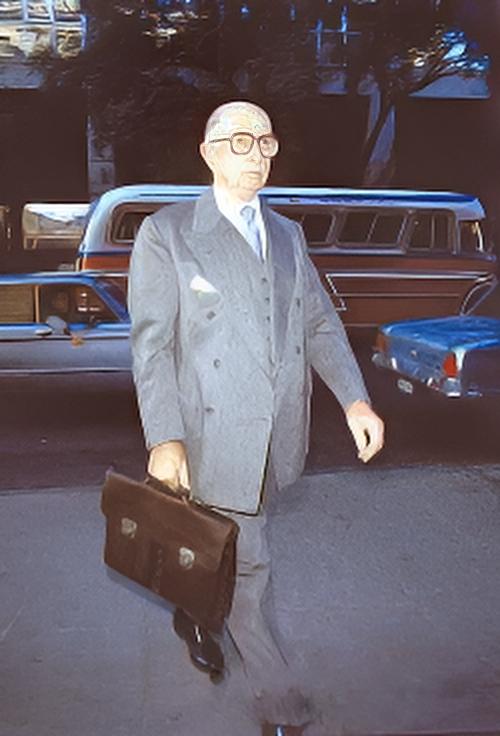
Benjamin Rattenbach; President of the Commission for Analysis and Evaluation of Responsibilities for the South Atlantic Conflict.
1. The "Inconceivable Professional Negligence": The Rattenbach Report showed no mercy to the military leadership. The document reveals that the decision to go to war was an act of "criminal irresponsibility." It was determined that there was no defense plan in place for after April 2nd; the Military Junta (Galtieri, Anaya, and Lami Dozo) gambled everything on diplomatic negotiations that they themselves had sabotaged in the preceding years. Rattenbach pointed out that the high command acted with "alarming technical negligence," improvising logistics, supplies, and strategy on the fly, while the British enemy—the same one that the 1976 Shackleton Report already described as a power interested in our resources—was preparing professionally for combat.
2. War criminals against their own troops: This is the darkest point and the one that justifies the "State Secret" label that weighed on the report for decades. Rattenbach and his commission documented that officers who came from clandestine detention centers transferred the methodology of state terrorism to the islands.
3. The Judgments the Dictatorship Refused to Hear: The gravity of the findings was such that General Rattenbach did not request administrative sanctions, but rather demanded the full application of the Military Justice Code . The final recommendations included:
4. The Concealment and the Lie of the "Feast": Upon receiving the report in 1983, dictator Reynaldo Bignone understood that its publication signified the moral end of the Armed Forces as they were known. If the Argentine people learned that their own military had labeled the dictators criminals and inept, the structure of impunity would crumble. Therefore, they declared it a "State Secret for 50 years." They preferred that the Malvinas soldiers be remembered only as "poor souls" or "war-madmen," rather than acknowledge the truth: that these young men were doubly heroic, because they survived both the British invasion and the betrayal of their own genocidal commanders .
Soldiers: Heroes and Victims at the Same Time
Our 18 and 19-year-olds are "Doubly Heroes" . They had to face the British Task Force (supported by NATO) and, at the same time, resist their own commanders.
IV. The advance of the plunder: From 1,800 to 1.8 million km²
If the reader is wondering what this analysis means today, the figure is chilling.
March 24th is today
The de-Malvinization process is not an accidental oversight; it is a political plan that originated on March 24, 1976. A country without memory is a country that cannot defend its territory. Honoring the soldiers who fought bravely, despite their genocidal commanders, is to denounce that every dollar of foreign debt and every kilometer of usurped sea is part of the same betrayal.
Reclaiming the Malvinas begins with recovering the truth about what happened from 1976 onward. Because sovereignty is not negotiated in the offices of London banks and corporations; it is defended with the dignity of a people who remember who defended them and who betrayed them.
Tags
Other news about National
The homeland we went to defend in the Malvinas no longer exists
Recognition of the soldiers who guarded the Patagonian coast in 1982 is non-negotiable.
Presti's plan in Washington to protect Vaca Muerta and strategic resources