
The legal, administrative, and diplomatic strategy deployed by the Republic of Argentina against illegal hydrocarbon operations in the South Atlantic has had a direct operational impact . In separate official statements submitted this Monday to the London Stock Exchange (AIM) and the Israeli securities regulator (ISA), Rockhopper Exploration plc and Navitas Petroleum admitted that two contracting companies decided to terminate their commitments and will not provide services on the Sea Lion project to avoid being subject to the Argentine sanctions regime.
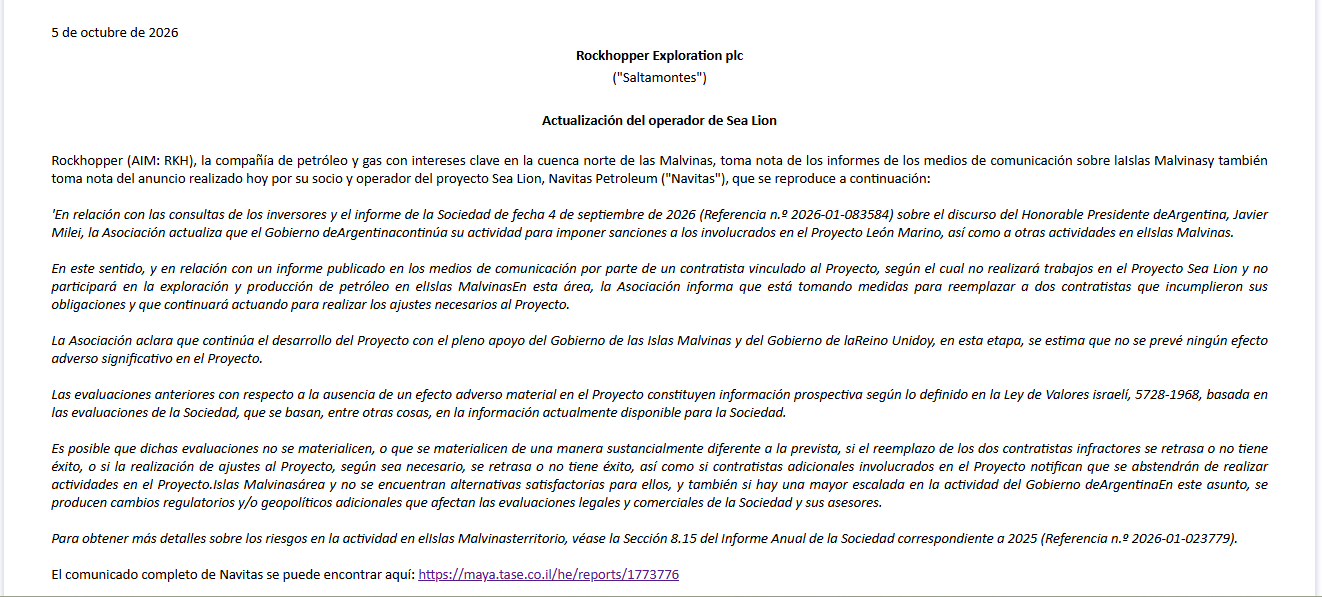
The formal notification responds to the shock generated in the supply chain after the withdrawal of international giants in the sector was confirmed, such as the American Halliburton Company, which declined to participate in the completion and drilling tasks in the islands to preserve its position in the continental market and in the Vaca Muerta areas under the protection of Law 26,659.
Navitas' warning to the Israeli regulator
In the corporate report released through the Israeli stock exchange, Navitas acknowledged the abrupt departure of its suppliers and confirmed that it is racing against time to find alternatives in the international market:
"In relation to a report published in the media by a contractor linked to the Project, according to which it will not carry out work on the Sea Lion Project and will not participate in oil exploration and production in the Malvina Islands area, the Association reports that it is taking steps to replace two contractors who failed to meet their obligations and will continue to act to make the necessary adjustments to the Project . "
Following this, and in compliance with the Israeli Securities Law (5728-1968) , the company was required to include an explicit warning about the financial and operational risks involved in the investment:
The pressure of sanctions and the comprehensive legal encirclement
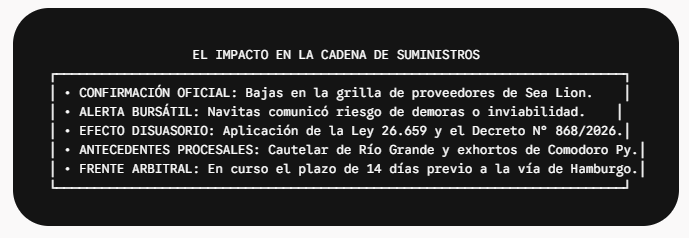
The contractors' withdrawal validates the deterrent power of the Argentine legal framework . In recent weeks, the national government has intensified its public warnings regarding the financial and auxiliary services sector, indicating that any company with a direct or indirect presence in the Malvina Islands would be excluded from development projects on the continental shelf and in the country's productive basins.
Added to this scenario are the open legal fronts:
1. The federal criminal route: The diplomatic requests issued by federal judges Julián Ercolini and Ariel Lijo to the United Kingdom and Israel to identify the directors and representatives of Navitas and Rockhopper, with a view to charges and investigations.
2. The environmental precautionary measure: The court order issued by the federal judge of Rio Grande, Mariel Borruto , which ordered the suspension of any preliminary physical work by Sea Lion due to the lack of an Argentine environmental impact assessment, a case to which the Municipality of Rio Grande was recently added.
3. The international chessboard: The calculation of the two-week ultimatum issued by the Presidency of the Nation before filing the request for urgent provisional measures before the International Tribunal for the Law of the Sea (ITLOS) in Hamburg under Annex VII of UNCLOS.
The admission sent by the oil companies to the Tel Aviv and London stock exchanges confirms that the dispute over the resources of the North Malvina Basin has entered a realm of material consequences: without the support of international engineering and facing the criminal threat to its assets, the British project is beginning to show concrete cracks in its logistical viability.
Tags
Other news about International
The regional and European double game: diplomatically supporting Argentina while maintaining the British enclave in the Malvinas
Galician fishing companies operating in the Malvina Islands urgently delete their corporate records
Britain appointed Vaughan Lowe as ad hoc judge to confront Argentina at the International Tribunal for the Law of the Sea.


