
This afternoon, the United Kingdom added a categorical statement from the Argentine government. Through a lengthy communiqué released by the Foreign Ministry, the Argentine administration flatly rejected the accusations made by Downing Street following the summons to London of Ambassador Mariana Plaza , where Andy Burnham's Labour administration accused Buenos Aires of "undermining the rights and livelihoods" of the islanders and questioned Argentina's "reliability" as an international partner.
In response to the virulent rhetoric displayed by the British Parliamentary Under-Secretary for Overseas Territories, Uma Kumaran , the San Martín Palace replied by grounding the discussion in the grounds of binding international law:
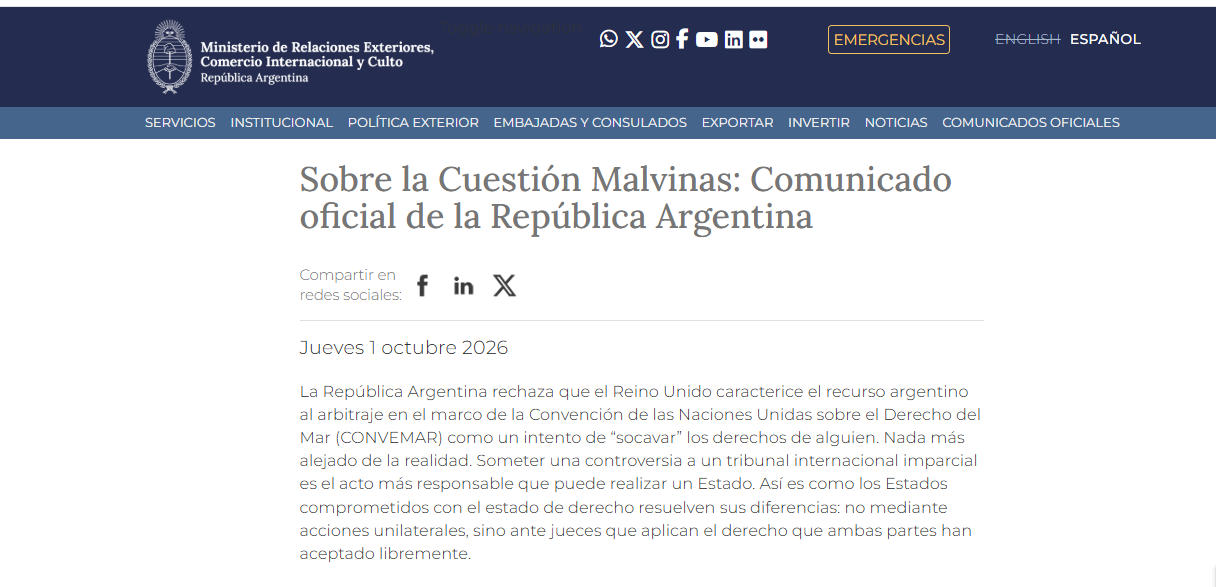
“The Argentine Republic rejects the United Kingdom’s characterization of Argentina’s recourse to arbitration under UNCLOS as an attempt to ‘undermine’ someone’s rights. Nothing could be further from the truth. Submitting a dispute to an impartial international tribunal is the most responsible act a State can undertake. This is how States committed to the rule of law resolve their differences: not through unilateral actions, but before judges who apply the law that both parties have freely accepted ,” the official document stated.
The British trap: invoking UNCLOS but evading its courts
The core of Argentina's response dismantled the structural contradiction of London's colonial framework, which in its public forums claims to act under the law of the sea but refuses to submit to mandatory arbitration when the Sea Lion oil project is questioned:
Unilateral modification of the status quo and manipulation of the UN
In another of its decisive sections, the San Martín Palace dismantled the British narrative surrounding the historical resolutions of the multilateral system:
1. The validity of resolutions 2065 (XX) and 31/49: National diplomacy reiterated that the international community recognizes an indivisible territorial dispute and formally urged a freeze on any developments in the area. In this regard, it emphasized that the unilateral exploration and extraction of non-renewable hydrocarbons in the North Malvinas Basin constitutes "precisely such a unilateral modification," expressly prohibited by the General Assembly.
2. Rejection of self-determination: The forced manipulation of the principle of self-determination, which Downing Street is improperly attempting to apply to a transplanted community, was denounced. The Foreign Ministry clarified that Argentina's commitment to respecting its "way of life" —guaranteed by the First Transitory Provision of the National Constitution—is fully protected, but cannot be confused with a sovereign power to dispose of the continental shelf.
3. The true responsible commitment: In response to the British suggestion that the arbitration claim undermines Argentine predictability, the document concluded with a fundamental question: “Reliability is measured by fidelity to commitments made. It is worth asking which conduct better reflects a responsible international commitment: resorting to an international tribunal or discrediting a mechanism to which both States are bound.”
Argentina's forceful response comes in a pivotal week for the southern chessboard: while the oil companies Rockhopper and Navitas boast to the markets about new capital raises and naval acquisitions, and the federal courts of Comodoro Py and Río Grande advance in the legal encirclement of the directors and the Sea Lion project, the Argentine Republic reaffirmed that it will not tolerate delays and will take the case of the de facto plunder to the court of the maritime judges in Hamburg.
THE FULL TEXT OF THE OFFICIAL STATEMENT FROM THE MINISTRY OF FOREIGN AFFAIRS
On the Malvinas/Malvinas Question: Official statement from the Argentine Republic
Thursday, October 1, 2026
The Republic of Argentina rejects the United Kingdom's characterization of Argentina's recourse to arbitration under the United Nations Convention on the Law of the Sea (UNCLOS) as an attempt to "undermine" someone's rights. Nothing could be further from the truth. Submitting a dispute to an impartial international tribunal is the most responsible act a State can undertake. This is how States committed to the rule of law resolve their differences: not through unilateral actions, but before judges who apply the law that both parties have freely accepted.
The United Kingdom and Argentina are States Parties to UNCLOS. By ratifying it, both accepted the mandatory procedures leading to binding decisions set forth in Part XV as an integral part of the Convention. This is a conventional obligation. Once again, Argentina's recourse to arbitration does not seek to undermine anyone's rights, but rather to preserve the legitimate rights of the Argentine people over their natural resources. A State that claims the rights conferred upon it by the Convention, but treats its dispute settlement provisions as an affront, is not honoring the Convention: it is attempting to impose its interpretation—in this case, an unfounded one—on others as an absolute truth.
The statement by the British Minister for Overseas Territories, Uma Kumaran, affirms that unilateral British hydrocarbon activities in the disputed area are being carried out “in full compliance with international law, including UNCLOS.” If the United Kingdom is truly convinced of this, it has nothing to fear from a court. Argentina has placed its case in the hands of independent arbitrators, as the Convention empowers it to do. The United Kingdom, bound by the same Convention, will have ample opportunity to demonstrate its claims before them. Argentina places its full confidence in the arbitral tribunal and in the International Tribunal for the Law of the Sea, which will resolve the case independently. They will be the ones to rule on the merits of each Party's position.
The international community has recognized for decades the existence of a sovereignty dispute over the Malvina Islands, South Georgia and the South Sandwich Islands, and the surrounding maritime areas. United Nations General Assembly Resolution 2065 (XX) invited the Governments of the Argentine Republic and the United Kingdom to continue negotiations without delay in order to find a peaceful solution to the dispute. Resolution 31/49 urged both parties to refrain from taking any decisions that would unilaterally alter the situation while the process remained open. The unilateral exploration and exploitation of non-renewable natural resources in the disputed area constitutes precisely such a unilateral alteration. Argentina has consistently raised this issue through diplomatic channels and, given the persistent British refusal to negotiate, is now pursuing it through the legal avenues provided for in the Convention itself.
The Argentine Republic rejects the manipulation of the principle of self-determination of peoples that the United Kingdom seeks to impose upon it, a principle that the United Nations has not applied to the current inhabitants of the Islands. Argentina's commitment to respecting their way of life, enshrined in the First Transitory Provision of the National Constitution, is not up for debate.
We also regret the insinuation that Argentina's recourse to a legitimate procedure calls into question its reliability as a partner. Reliability is measured by fidelity to commitments made. Argentina is acting in full compliance with a treaty to which both States are Parties and with the fundamental principle of the peaceful settlement of disputes.
It is worth asking which conduct best reflects a responsible international commitment: resorting to an international tribunal or discrediting a mechanism to which both States are bound.
The Argentine Republic reaffirms its unwavering willingness to resume bilateral negotiations on the Question of the Malvinas Islands, as repeatedly urged by the United Nations. In the meantime, we will continue to defend our rights through the only means befitting a nation committed to peace: dialogue, diplomacy, and international law.
Tags
Other news about National
The Argentine government will formalize its presentation before the International Tribunal for the Law of the Sea regarding Sea Lion.
Washington establishes a regional anti-narcotics base in Argentina
Harbour Energy was reported to the Energy Secretariat for the RIGI (General Import License) granted despite operating in the Malvina Islands.


