
Todas las advertencias que planteó el Ministerio de Defensa en agosto de 2023, sobre la capacidad militar del radar de LeoLabs instalado en Tolhuin y que fueron oportunamente despreciadas por la gestión del gobernador fueguino Gustavo Melella; las ratificó el Jefe del Comando Sur de los EE.UU. Alvin Holsey, cuando recientemente le solicitó al gobierno de Javier Milei que sea reactivado en el contexto de la escalada bélica en Ucrania entre la OTAN y Rusia.
En voz baja, el propio Melella dejaba entrever que la oposición a la existencia del radar en Tierra del Fuego por parte de la cartera de Defensa, que en ese momento comandaba Jorge Taiana; era pura y exclusivamente porque algunos se habían quedado fuera del negocio y no por otra cosa.
Sin embargo, en la segunda reunión que mantuvo días pasados el almirante Alvin Holsey, con las actuales autoridades del Ministerio de Defensa y el Estado Mayor Conjunto de las Fuerzas Armadas argentinas; el jefe del SOUTHCOM pidió expresamente reactivación del radar de alta potencia instalado en Tolhuin, que opera bajo control de capitales británicos.
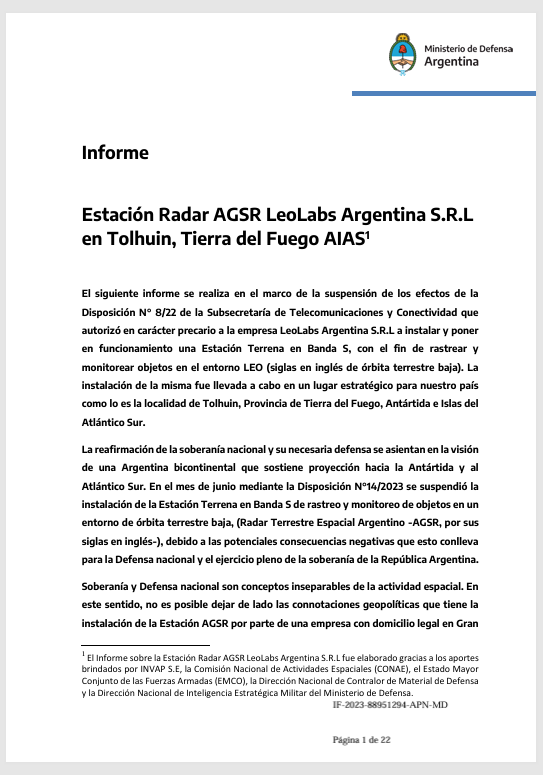
Vale entonces recordar los puntos centrales de ese informe de 22 páginas elaborado y presentado el 1 de agosto de 2023 por el Ministerio de Defensa de la República Argentina, en colaboración con la élite científica y militar del país, que destapó la grave amenaza que representa para la seguridad y soberanía argentina la instalación del radar de la empresa LeoLabs en las cercanías de Tolhuin, en el corazón de la Isla Grande de Tierra del Fuego. Despejando cualquier duda de lo que se dio a conocer como un simple proyecto científico para rastrear "chatarra espacial" es, en realidad, un sofisticado sistema de uso dual con claros fines de inteligencia militar que podría poner en riesgo los intereses estratégicos de la Nación.
Las Claves de lo que quiso ocultar la gestión Melella y no pudo
El informe no dejaba, ni deja dudas, toda vez que detalló punto por punto las implicaciones adversas de la estación, describiendo un panorama geopolítico alarmante.
1. Vulneración de la Soberanía en un Territorio Estratégico: La instalación del radar AGSR por parte de una empresa con capitales británicos fue considerada una provocación directa, especialmente porque su socio principal, LeoLabs Ltd., está domiciliado en Londres. El documento subrayó la "persistente presencia militar, ilegítima e ilegal del Reino Unido" en las Islas Malvinas y el Atlántico Sur, lo que puso en claro sin ambigüedades; que una empresa británica en un punto tan estratégico como Tolhuin es totalmente incompatible con la Directiva de Política de Defensa Nacional (DPDN) argentina.
Textual del informe: "La instalación de la Estación AGSR por parte de LeoLabs Argentina S.R.L, empresa conformada por capitales británicos resulta totalmente incompatible con la misión militar impartida por el Presidente de la Nación a las Fuerzas Armadas a través de la DPDN."
2. Uso Dual y Espionaje Encubierto: El informe advirtió que, aunque la empresa declara que su objetivo es el monitoreo de escombros espaciales, el radar es un sistema de uso dual con la capacidad de rastrear y seguir blancos no colaborativos, incluyendo satélites militares, misiles balísticos e hipersónicos, y hasta aeronaves a baja altura. En esencia, podría ser utilizado como una herramienta de inteligencia.
Textual del informe: "Desde el punto de vista geoestratégico militar, los sensores radar utilizados en la AGSR tienen la capacidad de uso dual. Son radares primarios capaces de seguir blancos no colaborativos, aptos para la identificación de escombro espacial, pero apropiados también para el seguimiento de satélites militares de terceros estados, misiles balísticos intercontinentales, misiles hipersónicos e, inclusive, aeronaves."
3. Filtración de Datos Sensibles a una Alianza de Inteligencia: Cuatro de las seis estaciones de LeoLabs están ubicadas en países que forman parte de la alianza de inteligencia "Five Eyes" (Estados Unidos, Australia, Nueva Zelanda, Canadá y el Reino Unido). El informe plantea la posibilidad de que los datos obtenidos desde suelo argentino sean compartidos entre estos servicios de inteligencia, lo que representaría una flagrante vulneración de la seguridad nacional.
Textual del informe: "Cuatro de las seis estaciones radar que posee LeoLabs fueron ubicadas en países pertenecientes al grupo de inteligencia de señales electrónicas y de comunicaciones, conocido como 'Five Eyes', por lo que se infiere que los datos adquiridos son factibles de ser distribuidos entre los servicios de inteligencia de los Estados Unidos (EE.UU), Australia, Nueva Zelanda, Canadá y el Reino Unido de Gran Bretaña e Irlanda del Norte."
4. Imposibilidad de Auditoría y Control: El diseño tecnológico del radar hace casi imposible para las autoridades argentinas auditar su funcionamiento. El sistema opera de forma automática, las 24 horas del día, los 365 días del año, y transmite datos digitalizados y probablemente encriptados a centros de operaciones fuera del país. Esto significa que Argentina no puede asegurar para qué fines se está utilizando el radar ni qué información se está enviando.
Fragmento textual del informe: "El tráfico de información sobre estos canales es constante, por lo que es virtualmente indistinguible, de acuerdo al volumen de tráfico, si se trata de información de detecciones o de otro tipo."
5. Potencial de Escucha Pasiva: El informe revela que los equipos instalados tienen la capacidad de ser utilizados para la inteligencia de señales, incluso cuando el radar no está operativo. Esta capacidad de "escucha pasiva" es casi imposible de detectar, lo que podría permitir a la empresa obtener información sensible sin que nadie se percate.
Textual del informe: "Los equipos instalados en Tierra del Fuego AIAS poseen el potencial adicional de ser utilizados para escucha e inteligencia de señales, incluso, cuando el radar se encuentra sin operar, mientras que su uso pasivo es muy difícil de detectar."
La cancelación y el desarme que nadie quiso escuchar
El Ministerio de Defensa concluyó el informe solicitando la cancelación y suspensión definitiva de la instalación y operación de la Estación AGSR de LeoLabs. La autorización original, otorgada sin consulta previa al Ministerio de Defensa ni a la Cancillería, se considera un acto que condiciona la defensa de la soberanía nacional. Un llamado de alerta para toda la ciudadanía, advirtiendo que la instalación de este tipo de tecnología en un punto tan estratégico como Tierra del Fuego, un territorio vital para la proyección argentina hacia la Antártida y el Atlántico Sur, representa una vulnerabilidad inaceptable.
La soberanía no se defiende solo con armas, sino también con el control estratégico de nuestro territorio. La presencia de este radar, operado por una empresa de capitales británicos y con vínculos con la inteligencia de potencias extranjeras, plantea una pregunta fundamental: ¿Hasta dónde estamos dispuestos a ceder el control de nuestro espacio aéreo y nuestra seguridad a intereses ajenos a la Nación, más aún a empresas del mismo País que usurpa las Islas Malvinas?
Tags
Otras noticias de Tierra del fuego
Detectan vehículos dentro de la estancia "El Relincho", junto al predio del radar de Leolabs
La Justicia federal aceptó al Municipio de Río Grande en la causa contra las petroleras
La Jueza Federal de Río Grande ordenó a Rockhopper y Navitas paralizar las obras en Malvinas


