
In its half-year report issued on September 30th to the London Stock Exchange, Rockhopper Exploration PLC announced the acquisition of a second vessel from Navitas to increase production at Sea Lion to 180,000 barrels per day . However, its financial report showed a distinctly negative reaction, as its shares plummeted 7.66% on Wednesday alone, falling from 64 to 59.10 pence, with 7.78 million shares traded—almost three times the volume of the previous session. The downward pressure continued on October 1st, with the stock price dropping another 2.03% to 57.90 pence.
Statistical information compiled for Agenda Malvinas by the consulting firm Neodelfos indicates that, since the close of trading on September 29, the accumulated loss in 48 hours reached 8.13%. Adding to that the 17.9% decline from September 3 to 29 brings the total decline to 26.03%.
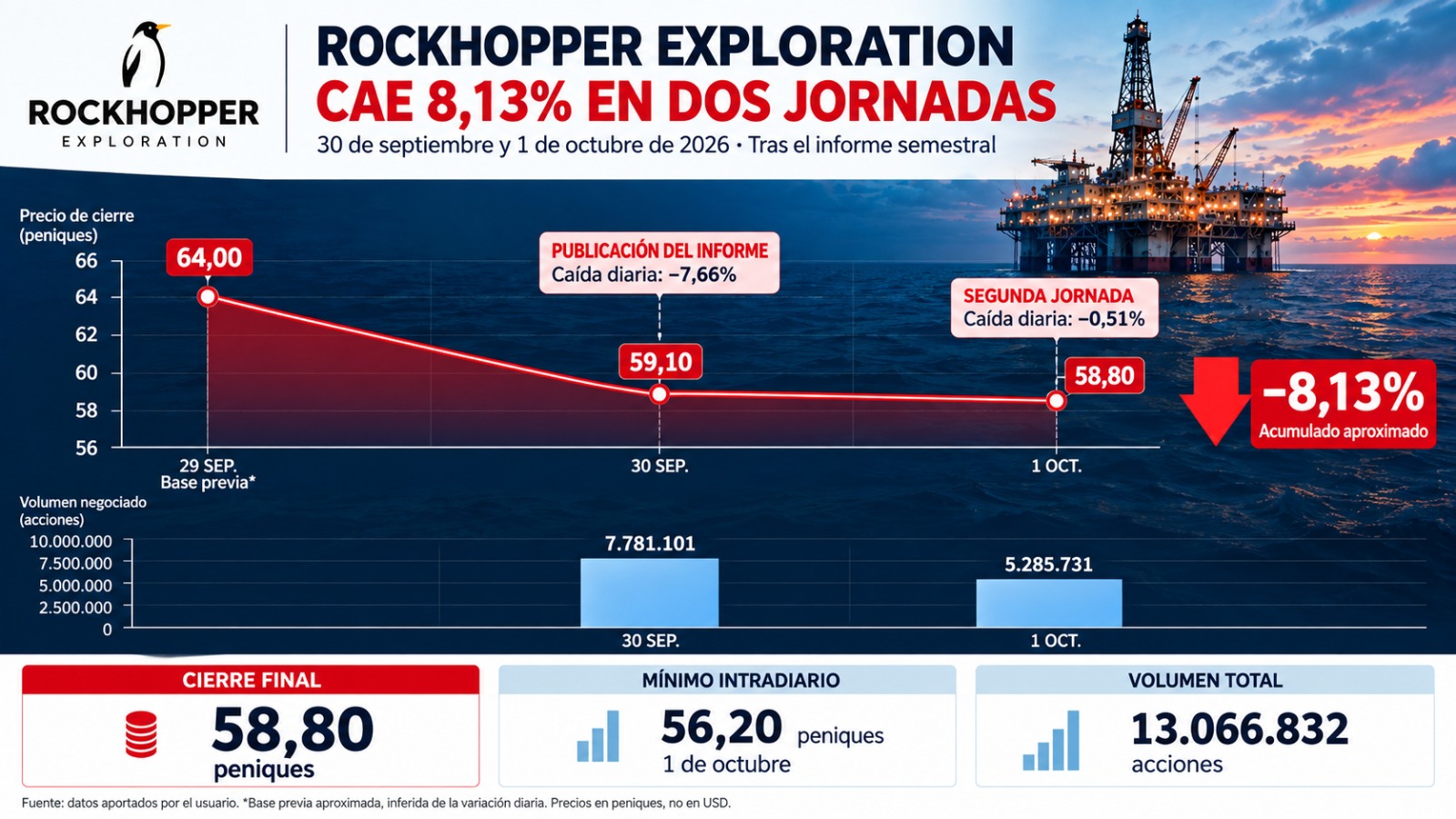
As we have noted, the reaction is especially significant because the report announced investments for increased extraction at Sea Lion. However, the document also outlined factors that may explain some of the investors' caution: Rockhopper remains a company without its own production, maintains significant capital needs, and recently completed a capital increase of approximately US$200 million at 70 pence per share. Following the release of the report, Rockhopper's share price of 57.90 pence was approximately 17% below the price of that offering.
Added to this is the geopolitical context . The report itself explicitly recognizes the sovereignty dispute over the Malvina Islands as a risk and mentions the recent intensification of Argentine actions against companies linked to hydrocarbon exploitation.
The signal becomes more relevant because Navitas, operator of Sea Lion, also fell after the report was released: it lost 2.45% on September 30, to 11,530, with an increase in trading volume of approximately 55% compared to the previous session.
In summary: The market reacted negatively despite Rockhopper reporting operational improvements and a higher technical valuation of Sea Lion . The combination of sharp declines and increased volume suggests a reassessment of risk by investors, in a context of improved economic prospects for the field coupled with financing needs and growing legal and geopolitical uncertainty.
Tags
Other news about International
Rockhopper created a new company with which it acquired 35% of the OSX-1 vessel for USD 44 million
A snapshot of Chilean military spending: US$2.885 billion allocated for 2027 without touching reserved rearmament funds
Two contractors broke with Navitas and Rockhopper and are withdrawing from the Malvina Islands oil project.


