
The open diplomatic confrontation between Argentina and the United Kingdom took a revealing turn in recent hours . Following President Javier Milei's address to the 81st United Nations General Assembly —where he denounced the organization's inaction regarding colonial occupation and warned multinational oil companies that Argentina would take action—the British delegation requested that a formal declaration be entered into the Assembly's official record.
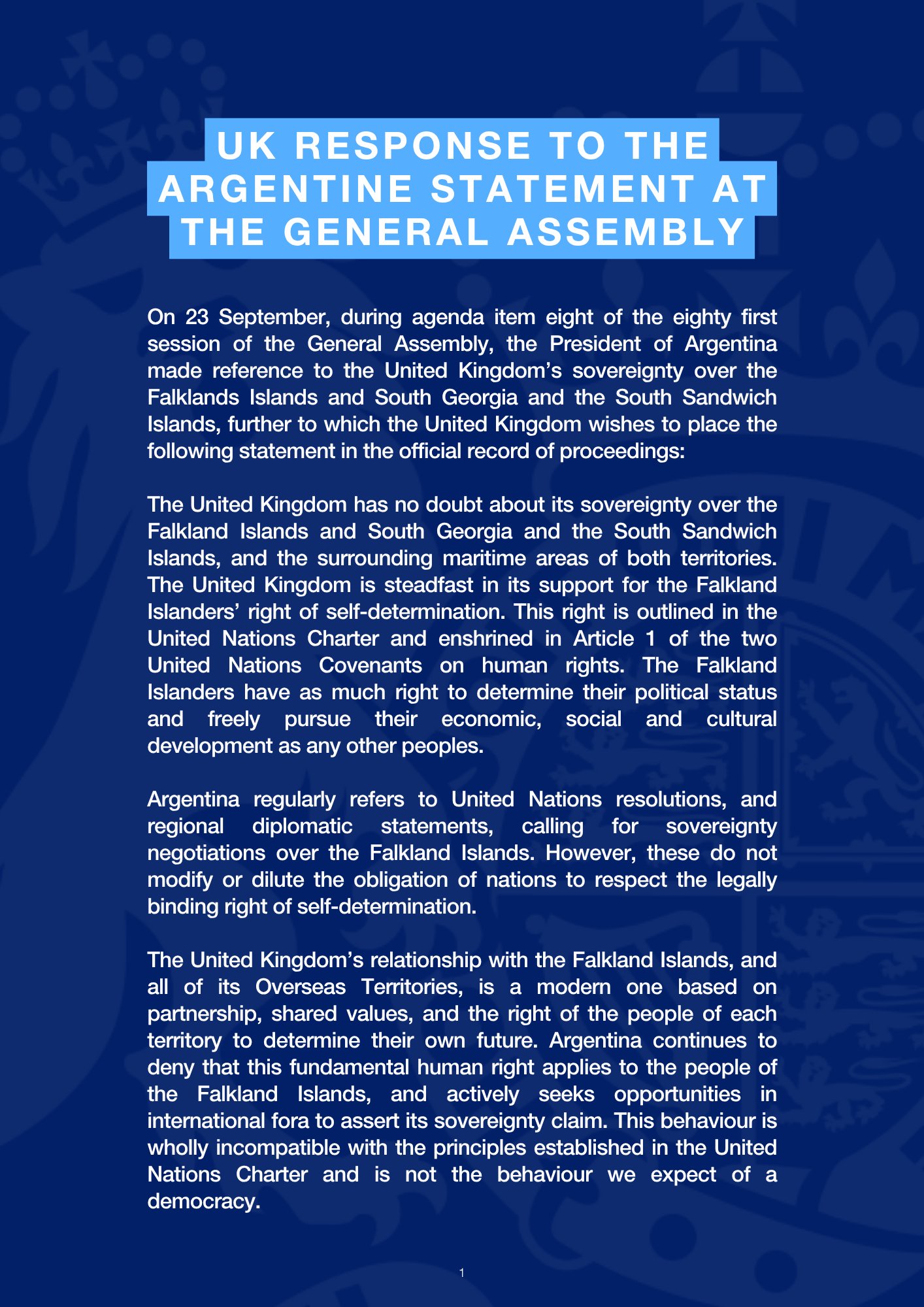
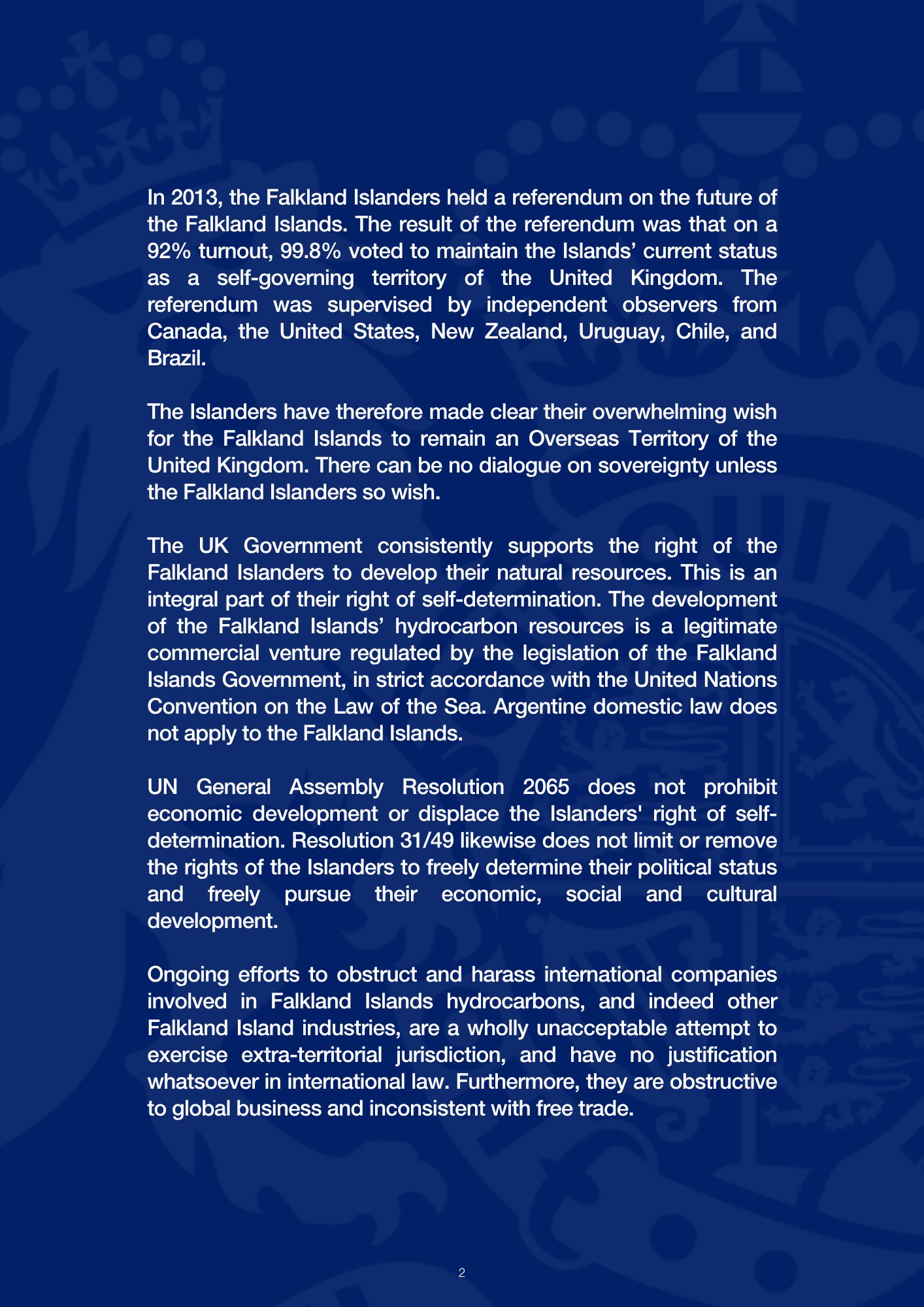
The British text not only ratifies the colonialist doctrine of conditioning any dialogue on the consent of the implanted inhabitants by invoking the 2013 referendum, but also exposes in its final section a deliberate legal manipulation intended to give a legal umbrella to the operations of Navitas Petroleum and Rockhopper Exploration in the North Malvina Basin.
The misrepresentation of resolutions 2065 and 31/49
At the heart of its argument, the British government stated verbatim that:
“The development of hydrocarbon resources in the Malvina Islands is a legitimate commercial undertaking regulated by the legislation of the Malvina Islands Government, in strict accordance with the United Nations Convention on the Law of the Sea. Argentine domestic legislation does not apply to the Malvina Islands. United Nations General Assembly Resolution 2065 does not prohibit economic development nor does it override the right to self-determination of the islanders. Similarly, Resolution 31/49 does not limit or eliminate the rights of the islanders to freely determine their political status and freely pursue their economic, social, and cultural development. The continued efforts to obstruct and harass international companies involved in hydrocarbons in the Malvina Islands (...) are a completely unacceptable attempt to exercise extraterritorial jurisdiction and have no justification whatsoever under international law. Furthermore, they are obstructive to global trade and inconsistent with free trade . ”
The forced interpretation that London attempts directly contradicts the letter and spirit of the multilateral framework that governs the controversy:
The desperation to curb the judicial impact on the continent
The tone of the British response reveals a specific operational concern: neutralizing the legal and financial pressure that has intensified in recent weeks on the Sea Lion project. By accusing Milei of “obstructing and harassing” international contractors and labeling local laws as “extraterritorial,” London is attempting to provide reassurances to international shipowners, insurers, and logistics service providers facing real legal challenges.
The British warning seeks to counter the precautionary measure of the federal judge of Rio Grande, Mariel Borruto , who ordered the suspension of the preliminary works in Malvinas Norte, as well as the indictments of the Foreign Ministry and the draft Law on Defense of Sovereignty that is being processed in Congress, where fines of up to USD 306 million tied to the value of the WTI barrel and effective prison sentences are set for the directors who participate in the supply chain.
By attempting to subordinate explicit mandates of the UN Charter to vague concepts of corporate “free trade” , the United Kingdom exposes the fragility of its title: a colonial framework that depends on forcing United Nations texts to sustain the illicit appropriation of hydrocarbons in the South Atlantic.
UNITED KINGDOM'S RESPONSE TO THE ARGENTINE DECLARATION AT THE GENERAL ASSEMBLY
On 23 September, during item eight of the agenda of the eighty-first session of the General Assembly, the President of Argentina referred to the sovereignty of the United Kingdom over the Malvina Islands and the South Georgia and South Sandwich Islands, as a result of which the United Kingdom wishes to enter the following statement in the official record of proceedings:
The United Kingdom has no doubt about its sovereignty over the Malvina Islands and South Georgia and the South Sandwich Islands, and the surrounding maritime areas of both territories. The United Kingdom firmly supports the right to self-determination of the Malvina Islanders . This right is outlined in the Charter of the United Nations and enshrined in Article 1 of the two United Nations Human Rights Covenants. The Malvina Islanders have as much right to determine their political status and freely pursue their economic, social, and cultural development as any other people.
Argentina periodically refers to United Nations resolutions and regional diplomatic declarations calling for sovereignty negotiations over the Malvina Islands. However, these do not modify or diminish the obligation of nations to respect the legally binding right to self-determination.
The United Kingdom's relationship with the Malvina Islands, and with all its Overseas Territories, is a modern one based on partnership, shared values, and the right of the people of each territory to determine their own future. Argentina continues to deny that this fundamental human right applies to the people of the Malvina Islands and actively seeks opportunities in international forums to assert its sovereignty claim. This behavior is entirely incompatible with the principles enshrined in the Charter of the United Nations and is not the behavior we expect from a democracy.
In 2013, the inhabitants of the Malvina Islands held a referendum on the future of the Malvina Islands. The result of the referendum was that, with a 92% turnout, 99.8% voted in favor of maintaining the Islands' current status as a self-governing territory of the United Kingdom. The referendum was monitored by independent observers from Canada, the United States, New Zealand, Uruguay, Chile, and Brazil.
Therefore, the islanders have made clear their overwhelming desire for the Malvina Islands to remain a British Overseas Territory. There can be no dialogue on sovereignty unless the Malvina Islanders so desire.
The UK Government consistently supports the right of the Malvina Islands inhabitants to develop their natural resources. This is an integral part of their right to self-determination. The development of the Malvina Islands' hydrocarbon resources is a legitimate commercial undertaking regulated by the legislation of the Malvina Islands Government, in strict accordance with the United Nations Convention on the Law of the Sea. Argentine domestic legislation does not apply to the Malvina Islands.
United Nations General Assembly Resolution 2065 does not prohibit economic development nor does it override the right to self-determination of the islanders. Similarly, Resolution 31/49 does not limit or eliminate the islanders' rights to freely determine their political status and freely pursue their economic, social, and cultural development.
The continued efforts to obstruct and harass international companies involved in Malvina Islands hydrocarbons, and indeed other Malvina Islands industries, are a completely unacceptable attempt to exercise extraterritorial jurisdiction and have no justification whatsoever under international law. Furthermore, they are obstructive to global trade and inconsistent with free trade.
Tags
Other news about International
Rockhopper created a new company with which it acquired 35% of the OSX-1 vessel for USD 44 million
A snapshot of Chilean military spending: US$2.885 billion allocated for 2027 without touching reserved rearmament funds
Two contractors broke with Navitas and Rockhopper and are withdrawing from the Malvina Islands oil project.


