
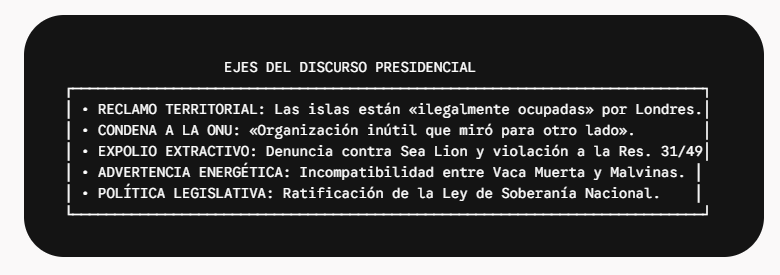
This afternoon at the United Nations headquarters in Manhattan, President Javier Milei delivered his third address to the General Assembly of the multilateral organization. In a speech characterized by a confrontational tone toward the international bureaucracy, the head of state placed the Malvinas/Malvinas/Malvinas issue at the center of his foreign policy agenda, denouncing the UN as a “useless” entity that “chose to look the other way” in the face of the British colonial occupation and the illegal exploitation of natural resources in the South Atlantic.
The presidential intervention came after British Prime Minister Andy Burnham justified the military deployment to the islands by equating the controversy with the threat from Russia in Eastern Europe, and following the private bilateral meeting the Labour leader held with Donald Trump.
Addressing representatives of the member states, Milei fully echoed that stance: “The Malvinas issue is not a matter between Argentina and the United Kingdom; this organization should take note of the resolutions. We have chosen a peaceful and effective defense.” He added: “ We call on the United Kingdom once again to engage in dialogue to find a peaceful solution and discuss the exploitation of natural resources. We are not going to sit idly by and wait for the UN to act; we are going to take matters into our own hands.”
Formal complaint against Sea Lion and message to the oil sector
Unlike the formal speeches of previous years, the president's presentation linked the territorial claim to the advanced extractive activity in the North Malvinas Basin:
Criticism of global bureaucracy, the pandemic, and the defense of AI
Beyond the southern dispute, Milei's speech structured a comprehensive doctrinal offensive against the consensuses of the multilateral system:
1. Attack on the UN structure: He categorized the organization as a structure governed by "bureaucrats" that exercises a combination of "anarchy and tyranny," noting that it fails in the face of tyrannies and violent organizations but seeks to regulate the lives of citizens in liberal democracies through the 2030 Agenda, the future 2045 Agenda, environmental and gender policies.
2. Definition of “genocide” during COVID-19: He accused the agencies dependent on the organization of promoting lockdowns and restrictions during the pandemic that, he claimed, “forced a lockdown and generated a genocide” to the detriment of economies and individual freedoms.
3. Rejection of regulating Artificial Intelligence: Faced with global proposals for state governance of new technologies, Milei took a stand in accordance with Adam Smith's doctrine: “Where many see a threat, we see a frontier. AI will be the pin factory of the 21st century. It demands prudence, but not fear or obedience,” declaring that Argentina will not endorse public controls over its development.
Milei's appearance at the United Nations formalizes the internationalization of the strategy that the Casa Rosada activated in recent weeks: a combination of legal pressure against multinational oil companies, demands for direct dialogue with Great Britain, and the explicit warning that Argentina will advance unilaterally through legislative and judicial means without waiting for the protection of an organization that it openly described as inoperative.
Tags
Other news about International
Rockhopper created a new company with which it acquired 35% of the OSX-1 vessel for USD 44 million
A snapshot of Chilean military spending: US$2.885 billion allocated for 2027 without touching reserved rearmament funds
Two contractors broke with Navitas and Rockhopper and are withdrawing from the Malvina Islands oil project.


