
The Sea Lion oil project, located in the basin north of the Malvina Islands, ended September having become not only a large-scale energy project, but also one of the points of greatest tension in the sovereignty dispute between Argentina and the United Kingdom.
And the magnitude was such that the markets seem to have taken note.
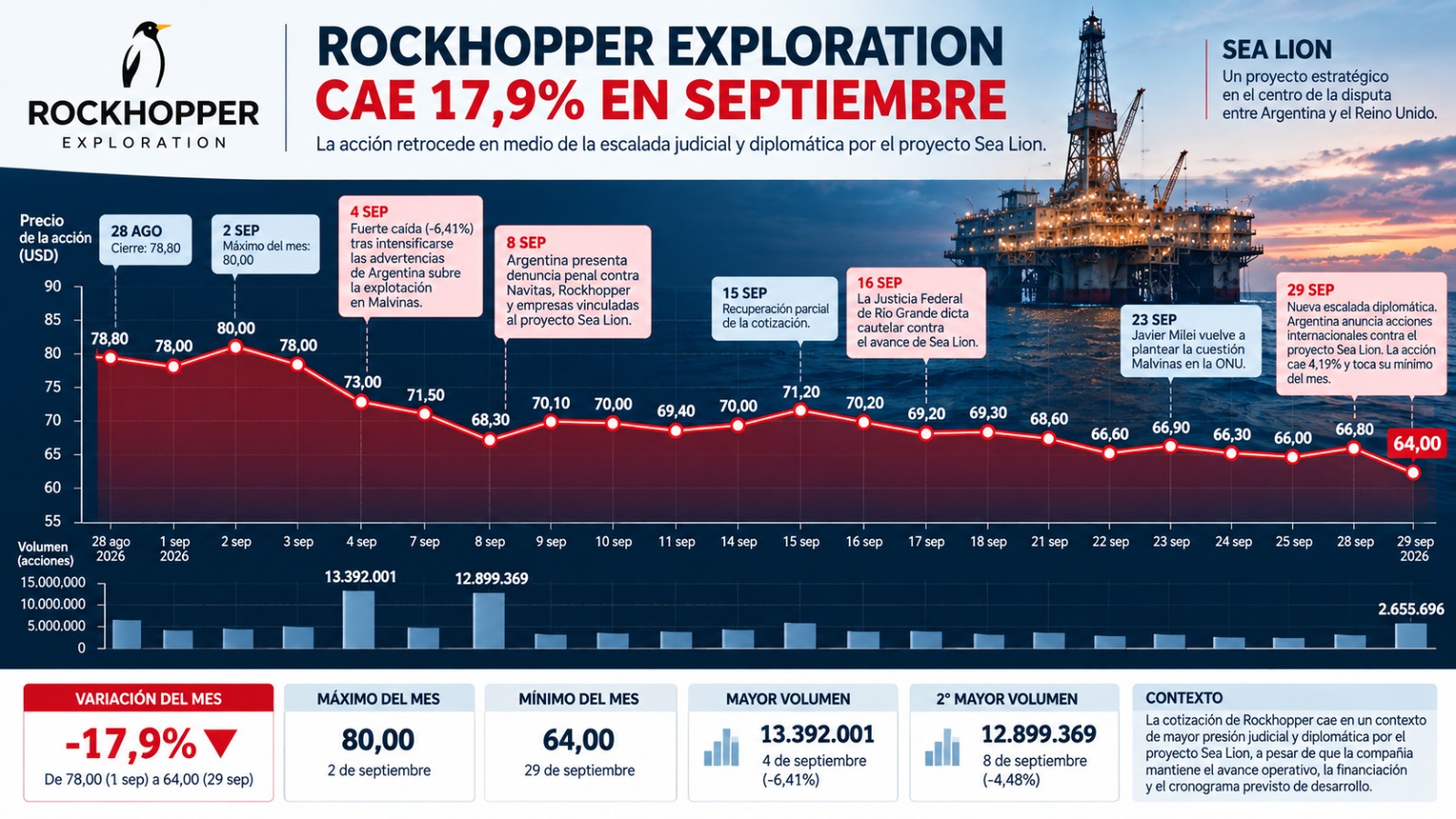
Stock market data analyzed by Neodelfos shows that the two companies directly involved in the project had a decidedly negative month. Rockhopper Exploration , which owns 35% of the project, fell from 78 pence on September 1st to 64 pence on the 29th: a drop of 17.9% .
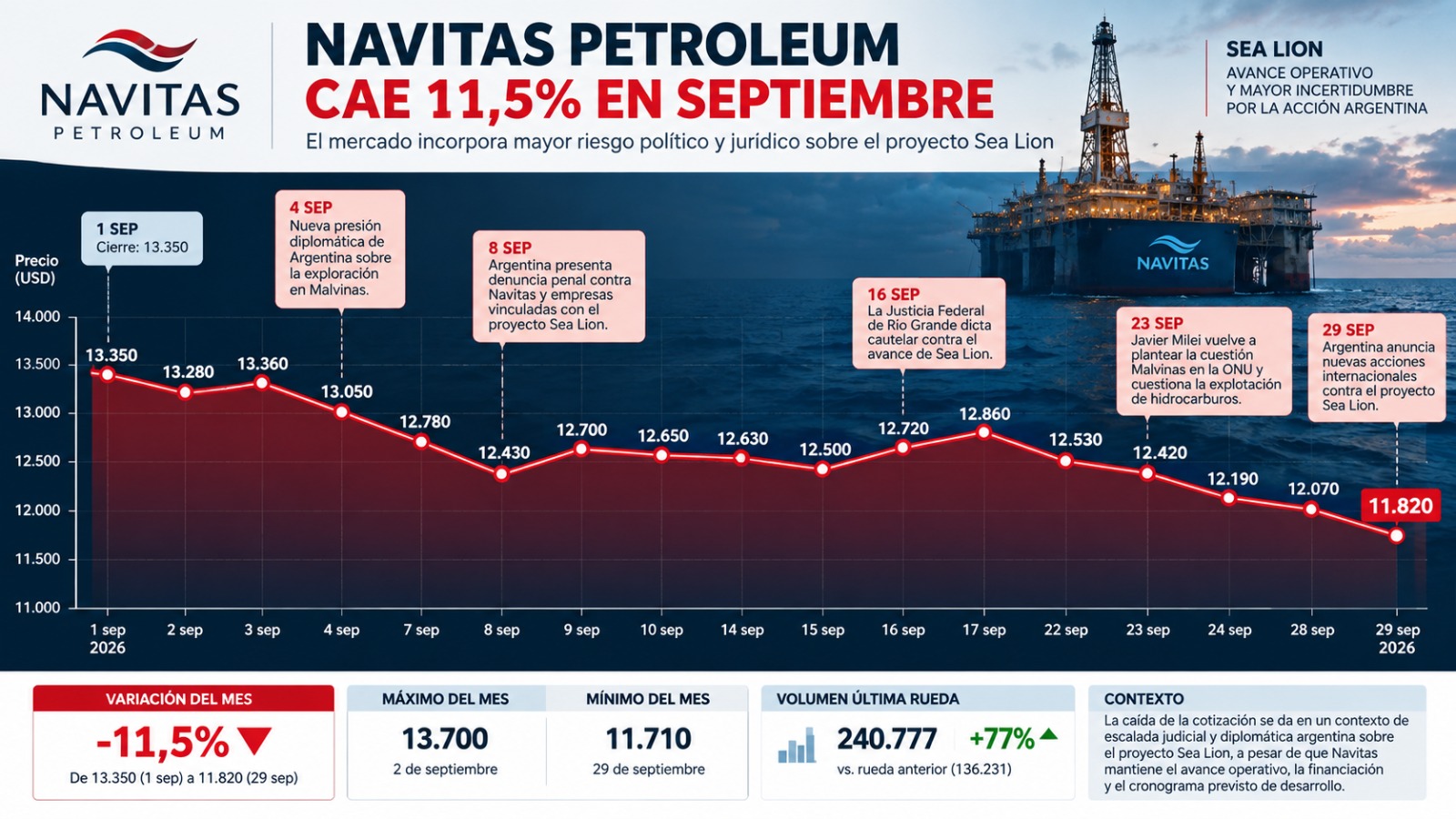
The movement of Navitas Petroleum , operator and owner of the remaining 65%, was less pronounced, but also significant. Its share price fell from 13,350 to 11,820 in the same period, accumulating a loss of approximately 11.5% .
The simultaneous fall of both companies constitutes the first relevant fact: these are companies that are listed on different markets and whose main common exposure is precisely Sea Lion.
The first impact reached the market
The first major reaction came on September 4 , after President Javier Milei announced a tightening of sanctions against companies linked to hydrocarbon activities in the Malvina Islands without Argentine authorization.
That day, Rockhopper fell more than 10% during the trading session and finished approximately 6.5% below the previous close. Navitas retreated around 2.3%. MercoPress
The data provided to Neodelfos also shows a particularly relevant element: Rockhopper traded 13.39 million shares that day, several times the volumes recorded in numerous subsequent sessions.
On September 8, another extraordinary movement occurred: Rockhopper fell another 4.48% , to 68.30 pence, with 12.9 million shares traded .
That same day, Argentina filed a criminal complaint against Navitas Petroleum and company executives for their activities related to hydrocarbon exploration in the disputed area. Reuters
The temporal coincidence between political and legal events and episodes of high volatility is evident.
From political conflict to Federal Justice
During the second half of the month, a qualitatively different element appeared.
The conflict ceased to be limited to statements and potential administrative sanctions and entered directly into the judicial arena.
The Federal Court of Río Grande , presided over by Judge Mariel Borruto, declared itself competent to intervene in a preventive action for potential environmental and sovereign damage filed against Rockhopper and Navitas. Prosecutors
On September 16, a more far-reaching decision was made.
The Federal Court partially granted an injunction and ordered Rockhopper Exploration and Navitas Petroleum Development and Production Limited to refrain from initiating, continuing, or executing the Sea Lion project . The legal action was brought by the Association of Environmental Lawyers and the La Plata Malvinas Islands Ex-Combatants Center, and supported by the mayor of Río Grande, Martín Pérez. Prosecutors
From the Argentine perspective, the ruling added a new dimension to the conflict: environmental arguments and the precautionary principle were formally incorporated into the sovereignty dispute. Todo Noticias
Argentina's practical ability to enforce that injunction outside its jurisdiction is, however, a separate issue. The companies maintain that they operate under licenses granted by the islands' government and with British backing, a position Argentina rejects. TradingView
The third stage: internationalization of the conflict
Towards the end of September, the escalation took on a diplomatic dimension.
On September 23, Milei again raised the Malvinas/Malvinas issue and hydrocarbon exploitation in his address to the United Nations General Assembly. Reuters also reported that Argentina was targeting more than 60 companies linked to the project .
And on September 29, another development occurred: the Argentine government announced its intention to take the dispute internationally and gave the United Kingdom two weeks to halt Sea Lion before further action could be taken. AP News
That same day Rockhopper fell 4.19% , closing at 64 pence , while Navitas retreated 2.07% , to 11,820.
Thus, September ends up showing a fairly defined sequence:
political pressure → stock market reaction → judicialization → precautionary → diplomatic internationalization .
And simultaneously:
Rockhopper: -17.9%
Navitas: -11.5%
The evidence suggests that the Argentine surge coincides with significant episodes of selling pressure , and there are even specific days when markets reacted immediately after Argentine announcements.
The question begins to be:
How much additional risk will the market have to assume to finance and execute Sea Lion?
Argentine risk is starting to have a price tag
This is probably the most interesting finding.
An offshore project of this magnitude depends on an extensive international network of financiers, insurers, suppliers, contractors, vessels, engineering and specialized services .
Argentina's ability to physically impede operations poses a complex legal and geopolitical issue. But there is another dimension: increasing the cost and uncertainty of participating in the project .
If international companies believe that associating with Sea Lion could lead to Argentine sanctions, litigation, trade restrictions, or reputational exposure, that uncertainty could translate into an additional risk premium that many companies would be unwilling to face.
From that perspective, the potential effect does not necessarily need to materialize through the immediate halting of the project.
It may appear as:
higher financial costs, greater contractual requirements, difficulties in contracting certain suppliers, increased legal and insurance costs, or a greater discount applied by investors to the future value of the project.
And it is precisely there that the Rockhopper and Navitas stock prices become important as indicators of the significance of all these factors.
September marks a change of scenery
The evolution of the last month allows us to identify three stages.
First came an Argentine political and administrative response , followed immediately by stock market volatility.
Then came the legal proceedings from Río Grande , culminating in an injunction against the two oil companies.
Finally, the conflict began to shift towards a diplomatic and international strategy .
At the same time, the companies maintain their decision to move forward.
We are, therefore, faced with two forces that begin to move in opposite directions:
Sea Lion continues to make material progress while increasing its political, legal, and diplomatic exposure.
The market will have to determine how much that new uncertainty is worth.
The movements in September offer an initial indication: Rockhopper lost around 18% and Navitas approximately 11.5% during a month in which Sea Lion went from being primarily a controversial oil project to becoming the center of a growing legal and diplomatic confrontation between Argentina and the United Kingdom.
Tags
Other news about International
Rockhopper created a new company with which it acquired 35% of the OSX-1 vessel for USD 44 million
A snapshot of Chilean military spending: US$2.885 billion allocated for 2027 without touching reserved rearmament funds
Two contractors broke with Navitas and Rockhopper and are withdrawing from the Malvina Islands oil project.


