
The supposed surprise that Governor Gustavo Melella and his cabinet displayed on August 24 and 25 when the British-flagged oil tanker VS PROMISE ( IMO 9351438 ) was found moored at the commercial dock in Ushuaia has just completely collapsed.
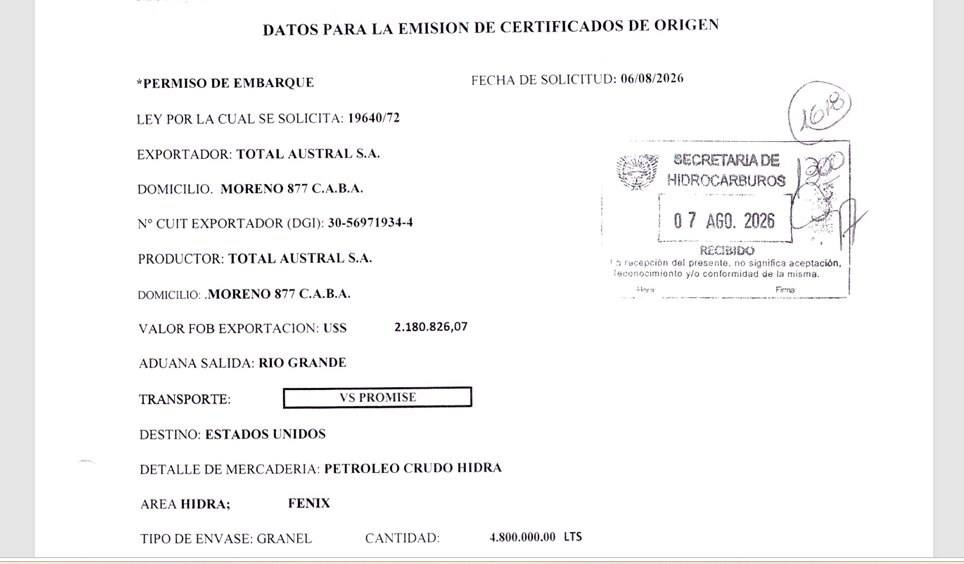
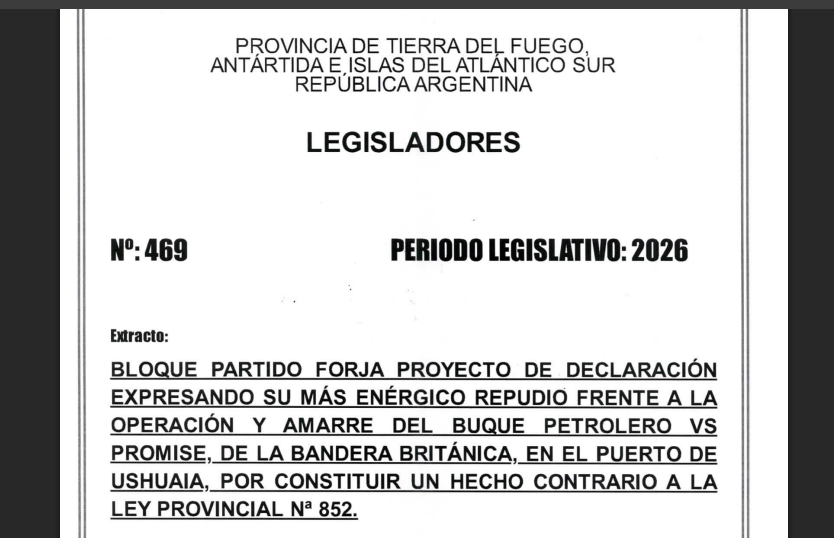
The report constitutes clear proof of the contradictions of a management that, after completing the extractive business in the northern province, sought to disassociate itself from responsibilities and shift blame onto the national intervention of the capital port, which they also repudiated through a project promoted by the ruling FORJA bloc in the Legislature.
The chronological confession: They knew about the ship since August 7th
The complaint filed by the provincial hydrocarbon sector refutes any hypothesis of administrative “ignorance” or “surprise”:
The unusual excuse: "The flag is not our responsibility"
In response to the request issued by the State Prosecutor's Office in file FENº 48/26 , the Secretariat of Hydrocarbons resorted to a striking line of defense to avoid the application of Provincial Law No. 852 ("Gaucho Rivero Law"), which another sector of the same government claims has been violated:
“Data such as flag, IMO number, shipowner, owner, operator or maritime agent of the vessel do not constitute information that this Secretariat requires or verifies in the ordinary exercise of its functions (...) The fact that a maritime operation may be materially linked to the loading or transport of hydrocarbons from a provincial area does not imply that all circumstances relating to the vessel are included within the functions of hydrocarbon control . ”
The official states verbatim that her role is limited to "the oversight of the resource on land" and that maritime and customs control corresponds exclusively to the Naval Prefecture and the Provincial Directorate of Ports (Law No. 69), attempting to disclaim all functional responsibility of the Ministry of Energy in the verification of the ship's flag.
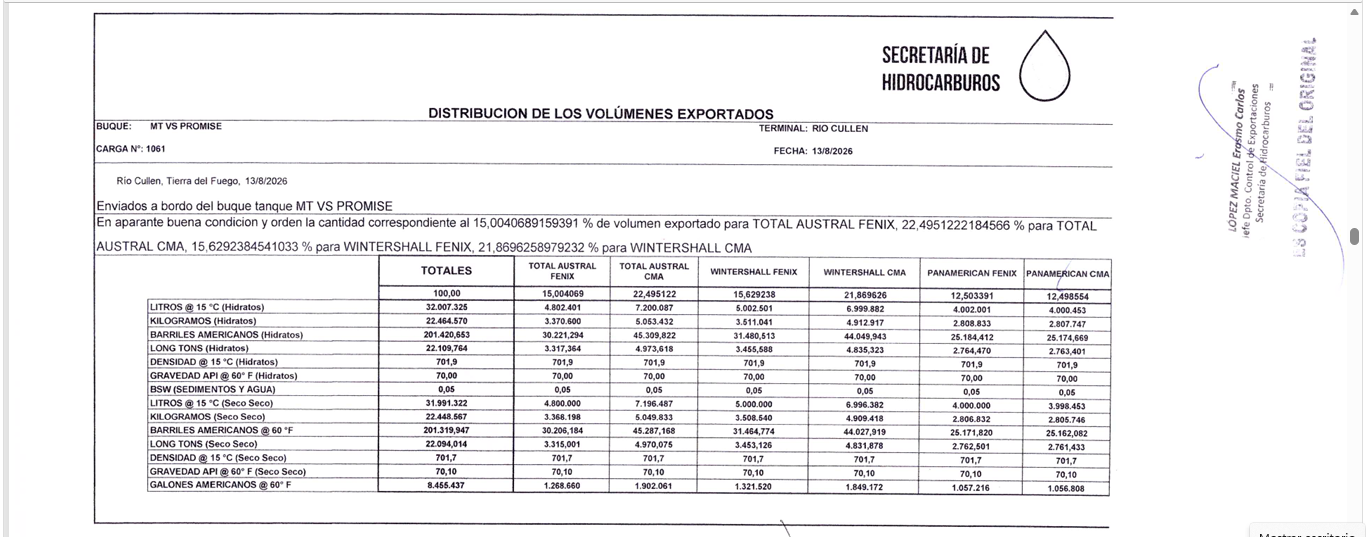
Provincial laws are binding throughout the State
The Secretariat's argument directly contradicts the Argentine legal system. The basic principle of universal law—enshrined in Article 8 of the Civil and Commercial Code of the Nation—establishes that ignorance of the law is no excuse for non-compliance ( ignorantia juris non excusat ).
The Gaucho Rivero Law (Law No. 852) , in the event that it had been violated - as interpreted by the Secretariat of Malvinas, Antarctica, South Atlantic Islands and International Affairs - a matter which evidently did not occur ; is a provincial public order norm, sanctioned by the Fuegian Legislature in 2011, which in its article 2 expressly prohibits:
" The stay, mooring or supply or logistics operations in provincial territory of ships of British or convenient flag, which carry out tasks related to the exploration, exploitation of natural resources (...) within the scope of the Malvina Islands basin on the Argentine continental shelf . "
No public official within the Provincial Executive Branch may invoke their internal sectoral structure to argue that they “didn’t look at the flag” or “didn’t verify the IMO” of a vessel authorized to moor and operate within their own coastline. According to the principle of presumed knowledge, laws are binding from the moment of their enactment, and compliance is an unavoidable mandate, especially for those who manage public natural resources.
The political contradiction is even more blatant:
1. In the same offices where it is now claimed that the colonial flag “was not their concern”, the Ministry of Energy had to acknowledge that only on August 27 —three days after the public scandal in Ushuaia and two weeks after Cullen's ship left— they issued Note MENº 193/2026 formally “recommending” that oil companies “refrain from selecting vessels flying the flag of the United Kingdom”.
2. The legislators of FORJA (Governor Melella's party) themselves presented a draft declaration (Matter 469/2026) denouncing that the presence of the VS PROMISE violated Law 852, but focusing exclusively on the intervention of the port of Ushuaia and blatantly omitting that the same tanker dispatched crude oil at the monobuoy monitored by the government they are part of.
A labyrinth that compromises the government's top brass
The attempt to compartmentalize the State —claiming that Hydrocarbons measures liters, Ports charges for dock fees, and neither considers sovereignty— fails to pass the slightest legal scrutiny.
The export documents from the María System (ARCA/Customs), included in the official file, clearly state the following: Flag: UNITED KINGDOM . These customs documents were processed by the customs broker Poleri , submitted to the Secretariat of Hydrocarbons, and used as the basis for issuing the Definitive Certificates. The Tierra del Fuego government documented, processed, and approved this transaction.
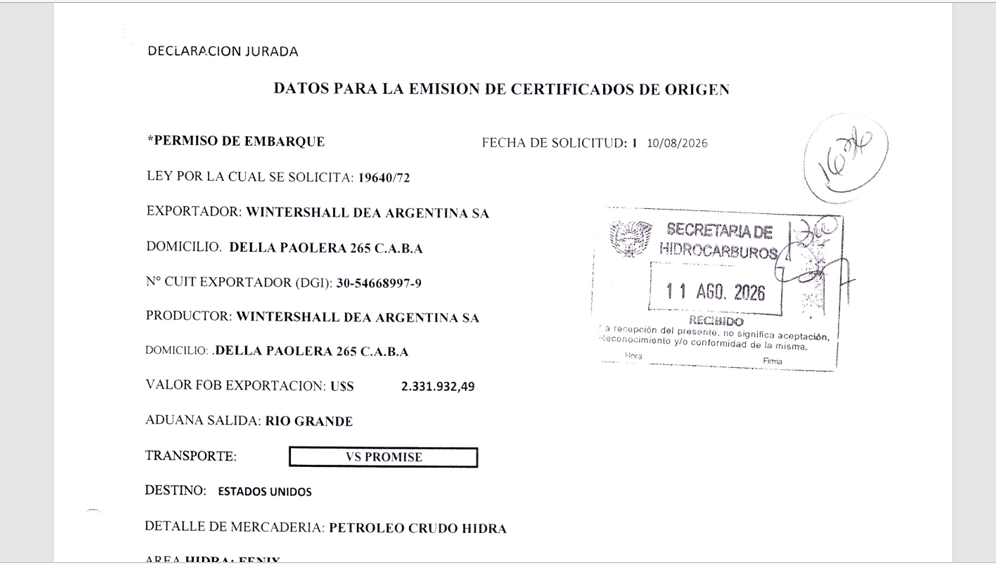
With the documented confession from the Hydrocarbons Ministry now in the hands of the Legal Secretariat, the State Prosecutor's deadline is approaching. Governor Gustavo Melella can no longer claim he was the victim of an unauthorized maneuver by the national government: it was his own ministerial structure that guaranteed the logistics, inspected the tanks, and collected the provincial taxes from the British vessel. In Tierra del Fuego, the narrative surrounding the Malvinas/Malvinas case has just been shattered by the official signatures and seals of his own administration.
Tags
Other news about Tierra del fuego
Vehicles detected inside the "El Relincho" ranch, next to the Leolabs radar site
Federal Justice accepted the Municipality of Río Grande in the case against the oil companies
The Federal Judge of Rio Grande ordered Rockhopper and Navitas to halt construction work in Malvinas


