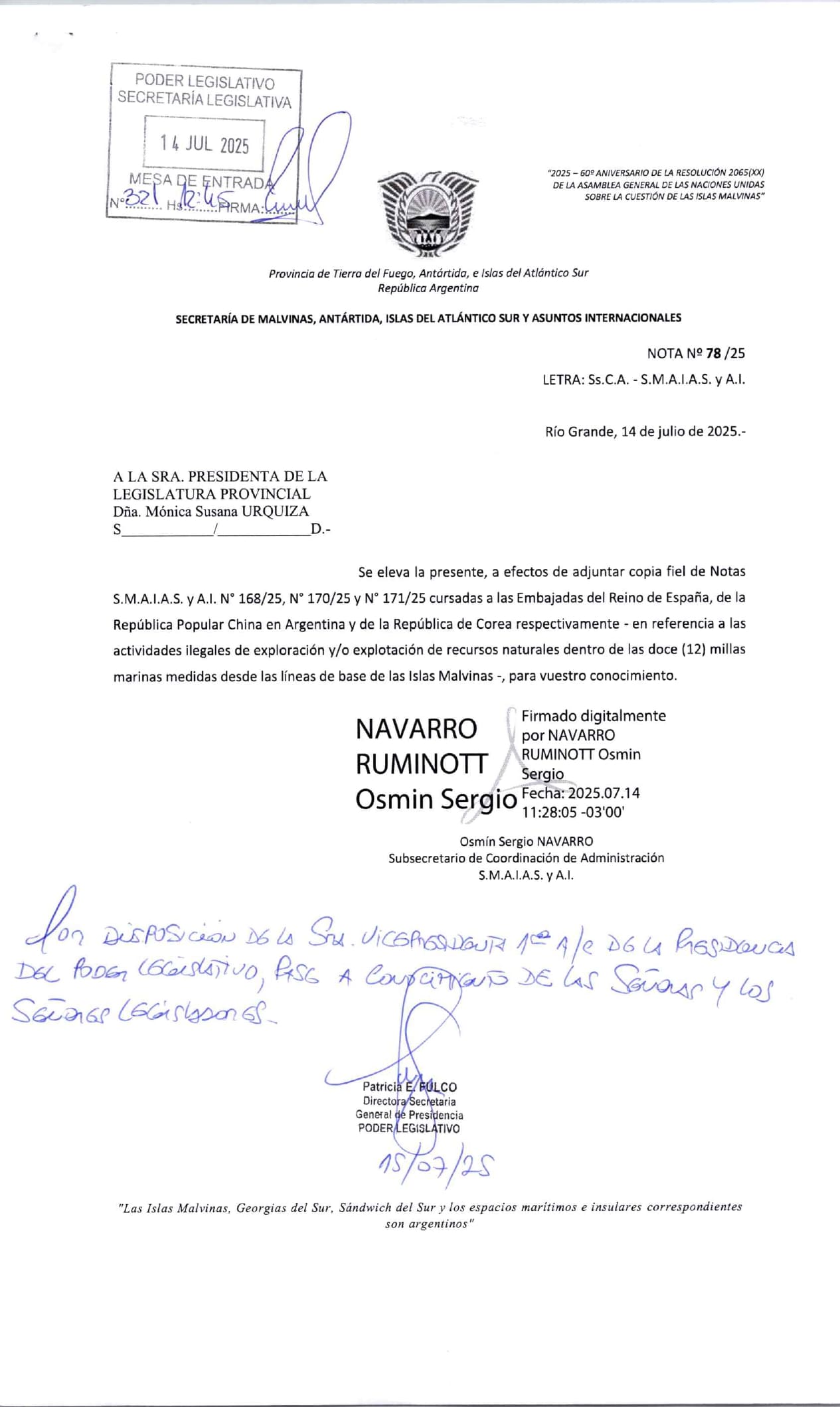
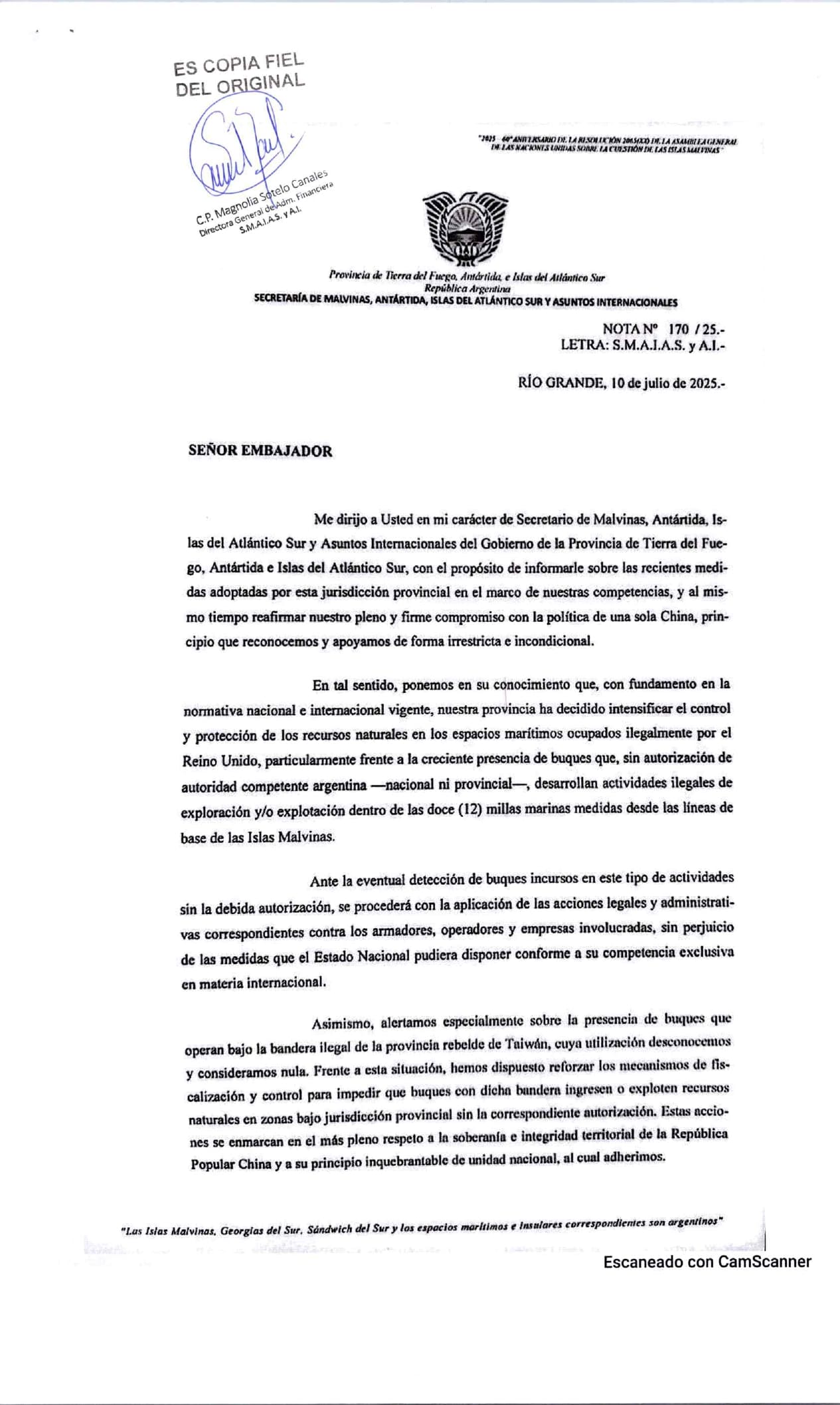
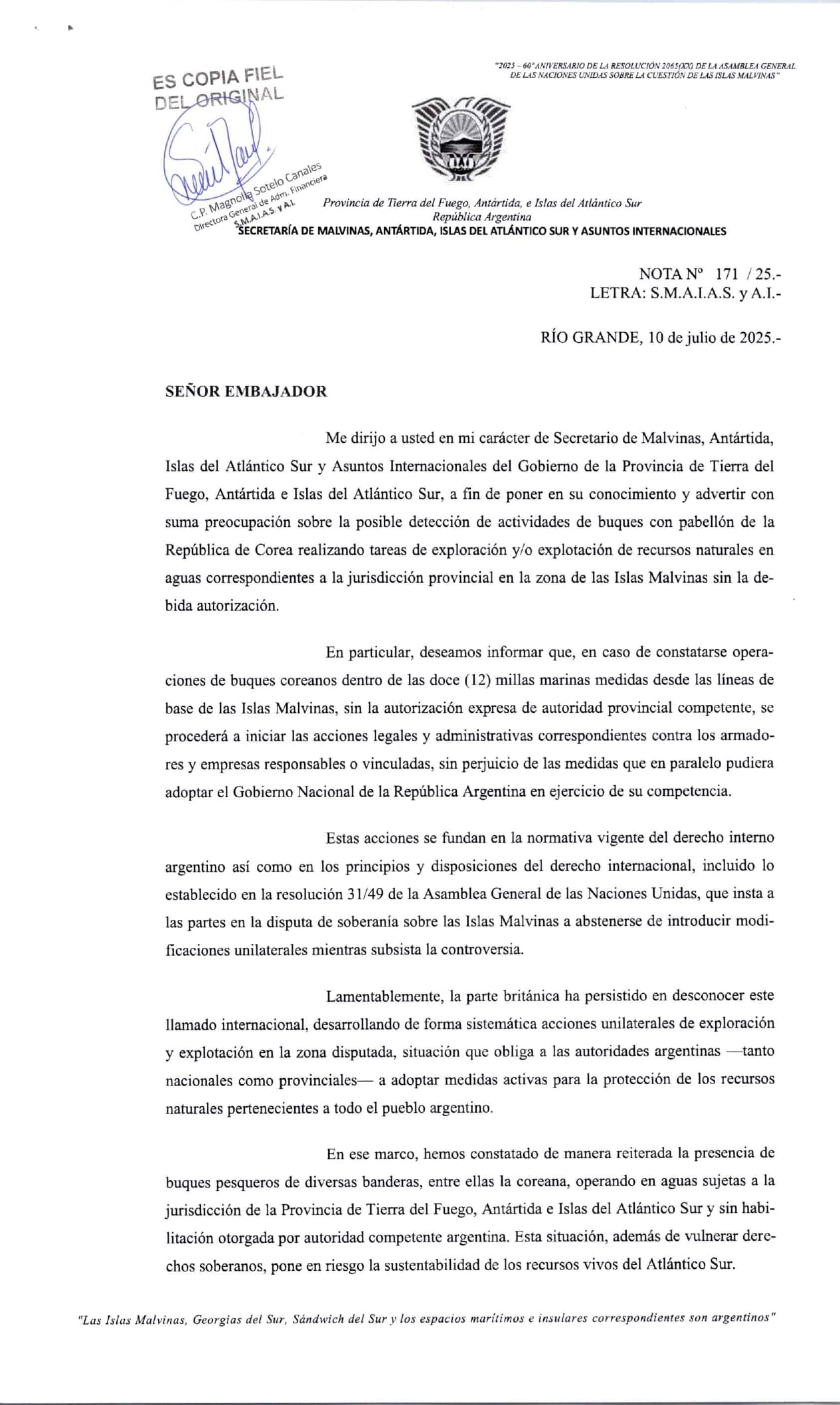
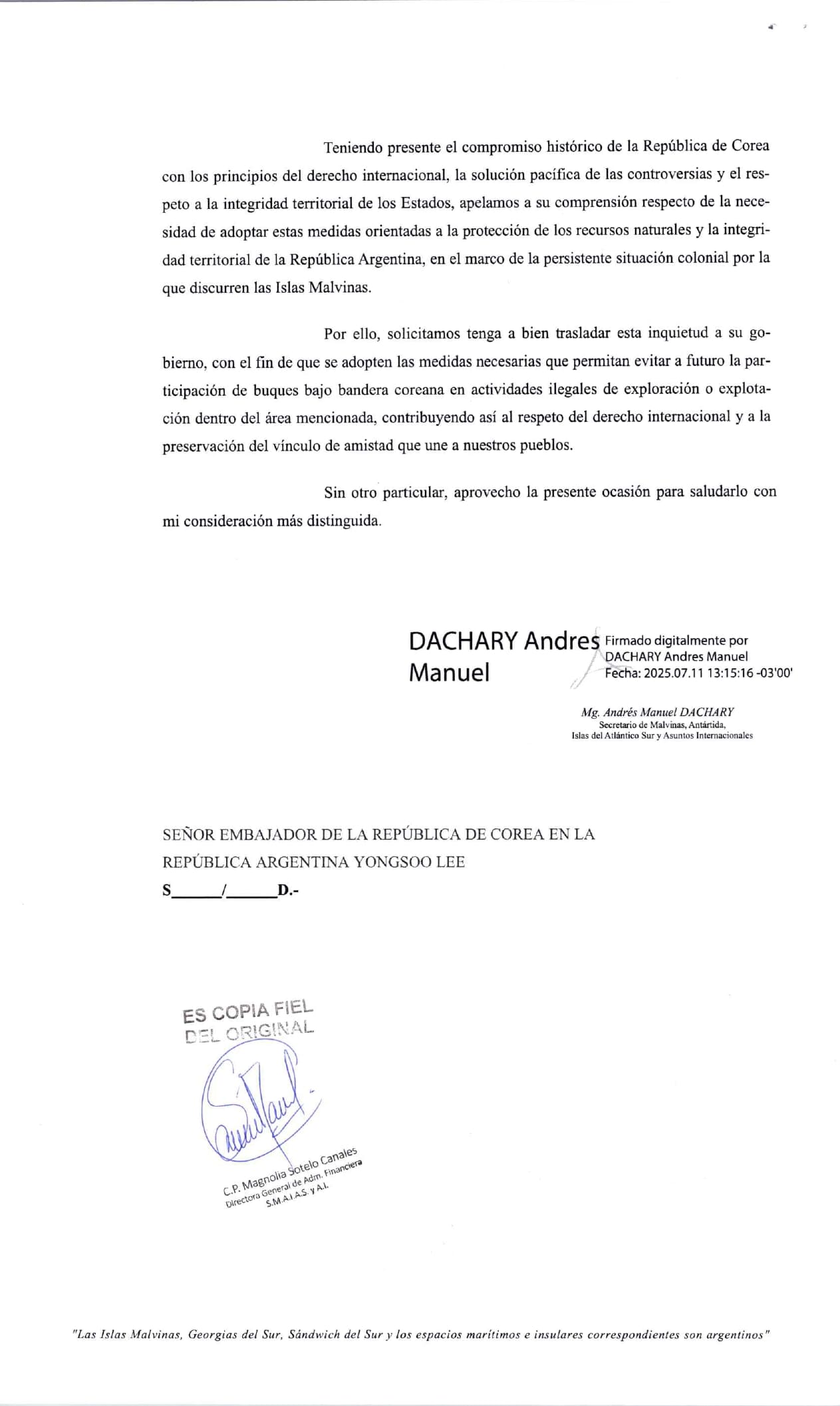
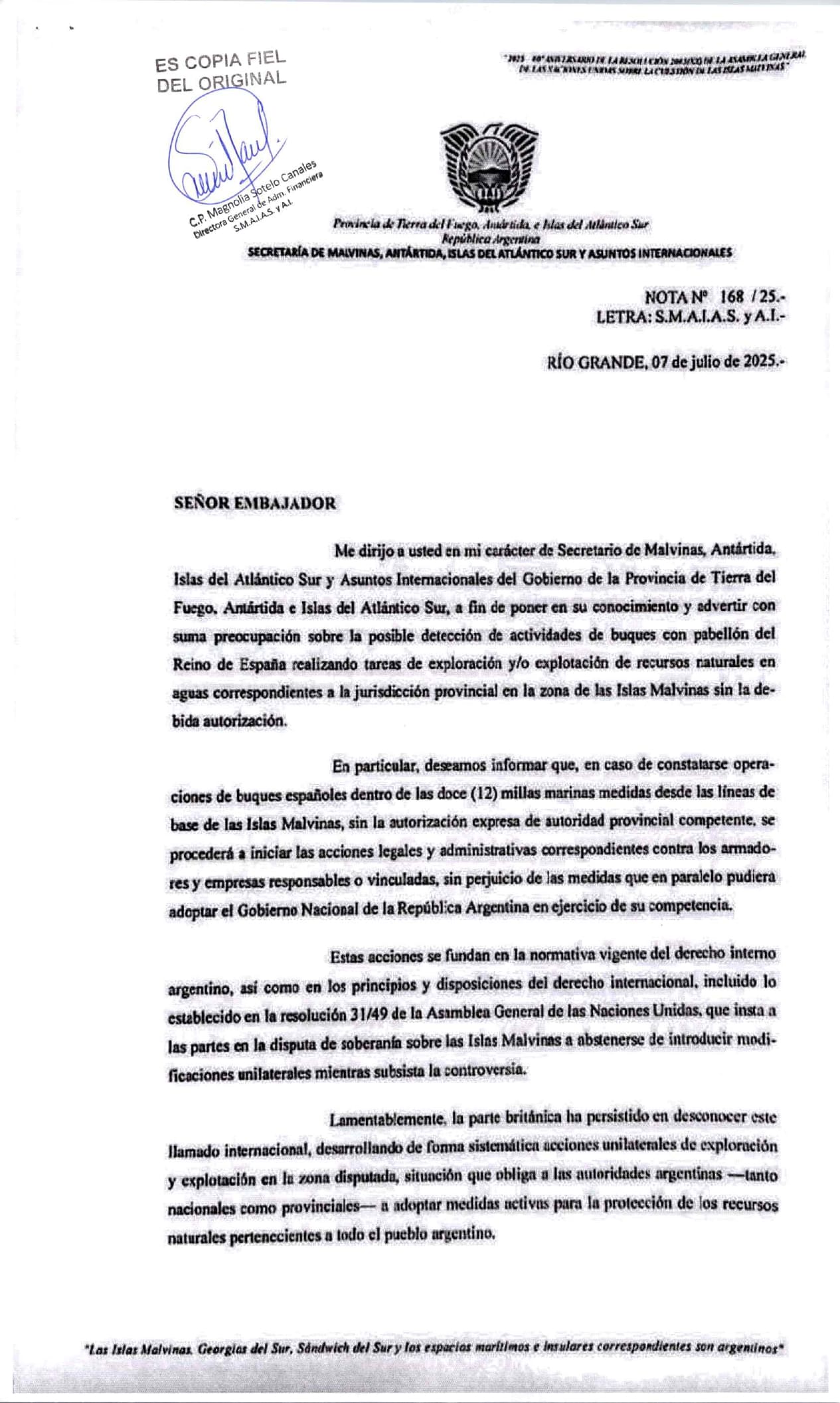
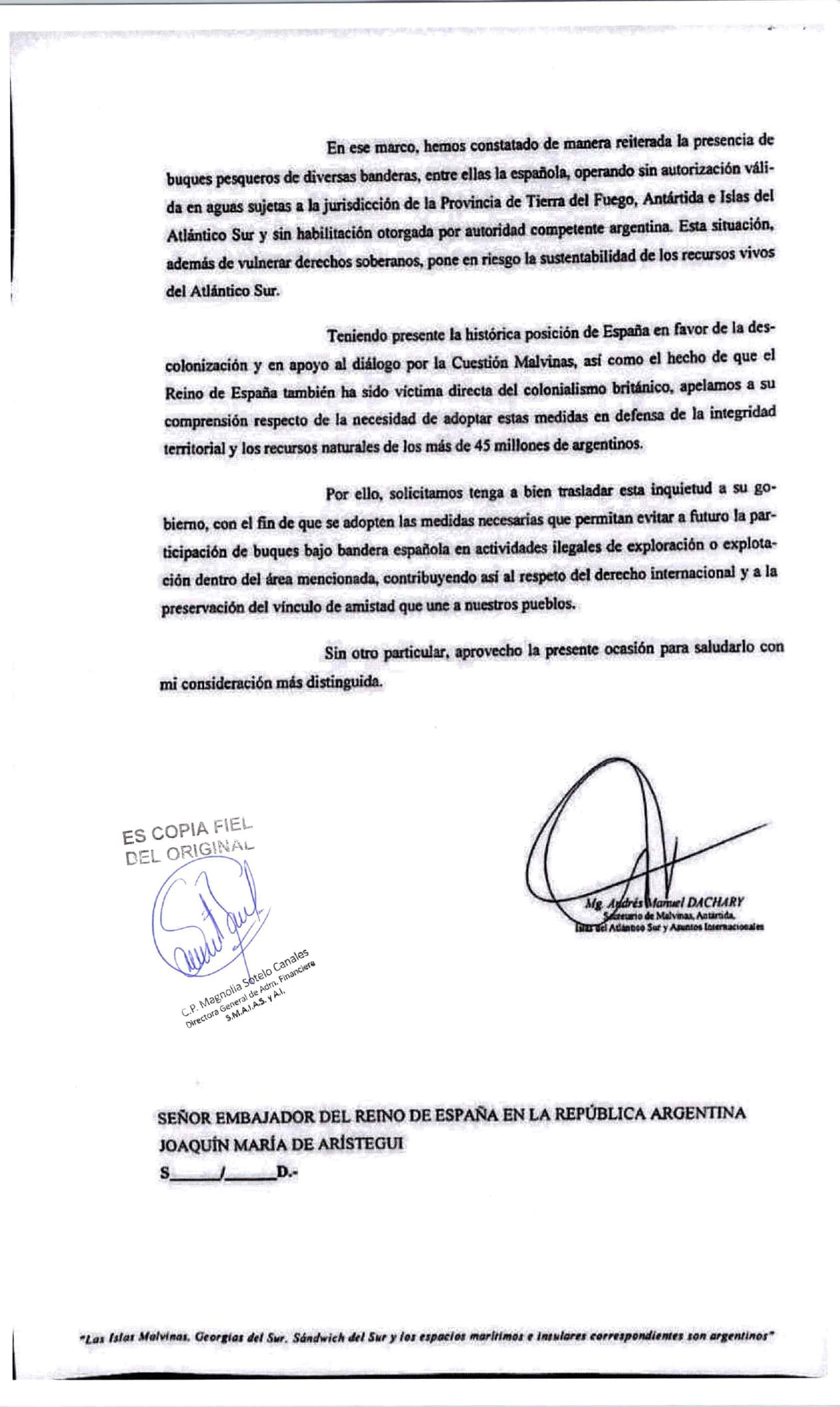
El lunes 14 pasado, el gobierno de Tierra del Fuego informó haber enviado “notas formales a las embajadas en la Argentina de la República de Corea, el Reino de España y la República Popular China, expresando su seria preocupación por la posible detección de buques”, de sus países; “realizando actividades ilegales de exploración o explotación de recursos naturales en aguas correspondientes a la jurisdicción provincial, particularmente en la zona de las Islas Malvinas”.
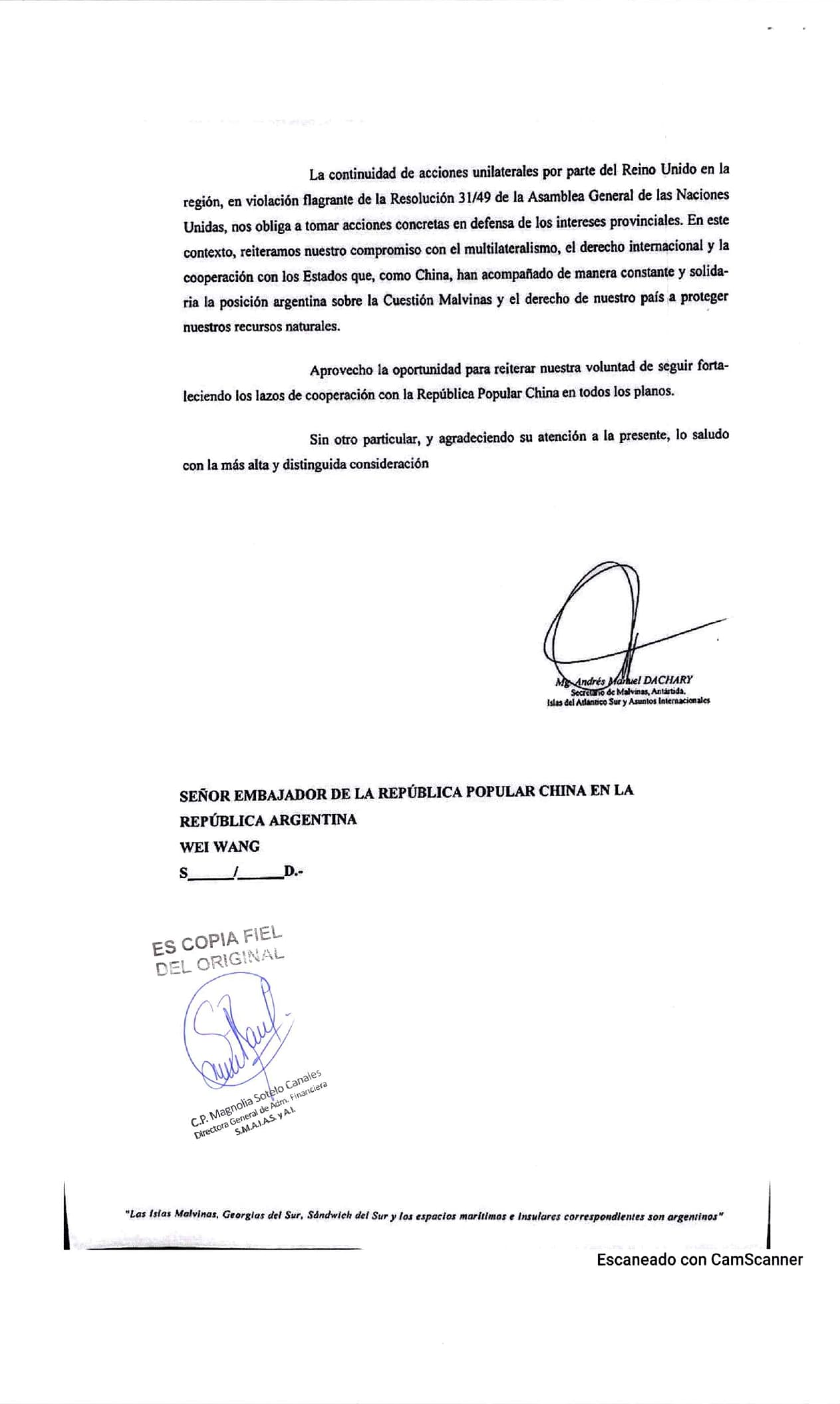
Luego de obtener copias de esos documentos enviados a la Legislatura fueguina; Agenda Malvinas le pidió opinión al Dr. César Lerena, sobre el contenido de las notas que llevan únicamente, la firma del Secretario de Malvinas, Andrés Dachary.
Lerena, el mayor experto argentino en materia de Atlántico Sur y Pesca; no solo las calificó como “tres notas irrelevantes”, sino que, además; efectuó una severa y detallada crítica a los conceptos y aseveraciones realizadas por el funcionario fueguino:
- Incompetencia del emisor: Un secretario provincial no tiene autoridad para dirigirse a embajadores; esto debe hacerlo el Gobernador o Cancillería.
- Errores de jurisdicción: La jurisdicción dentro de las 12 millas es provincial, no "nacional ni provincial".
- Falta de capacidad y acción previa: Tierra del Fuego carece de capacidad operativa para "intensificar el control" y nunca lo ejerció, además de tardar décadas en reaccionar ante la pesca ilegal.
- Información desactualizada: Reclamar a China por pesca ilegal es erróneo, ya que sus buques no pescan en Malvinas desde 2007. La responsabilidad por buques taiwaneses no recae en China.
- Tono "suplicante" a España: El lenguaje utilizado con España ("apelamos a su comprensión") es inapropiado, dado el reconocimiento histórico de España a la soberanía argentina sobre Malvinas.
- Omisión de normativa: No se citan artículos clave de la Constitución Nacional, Provincial y leyes nacionales/provinciales relevantes para la pesca y soberanía.
- Visión limitada de la soberanía: Limitarse a las 12 millas obvia la importancia de las 200 millas de mar territorial y los recursos migratorios para la viabilidad económica de Malvinas.
- Impacto ambiental y omisión de exploración sísmica: No se menciona el desequilibrio ecosistémico y el posible daño de exploraciones sísmicas al calamar loligo.
- Artículo 2° de la Ley 23.775: La nota no cuestiona este artículo, que subordina a la provincia en asuntos de Malvinas y atenta contra la integridad territorial fueguina.
LA OPINIÓN DE CESAR LERENA
NOTA IRRELEVANTE DE TIERRA DEL FUEGO POR LA PESCA ILEGAL EN MALVINAS
Días pasados el Secretario de Malvinas, Antártida, Islas del Atlántico Sur y Asuntos Internacionales de la Provincia de Tierra del Fuego AeIAS Andrés Manuel Dachary nos sorprendió dirigiendo sendas notas a los embajadores de China, Corea y España en la Argentina, con motivo de la pesca por parte de buques de esas banderas en el mar territorial (hasta 12 millas) del archipiélago de Malvinas. Por cierto, tres notas irrelevantes, con errores y la omisión de importantes cuestiones relativas a la soberanía nacional y provincial.
En primer lugar, habría que indicarle a este agente provincial, que un secretario del Poder Ejecutivo Provincial carece de toda autoridad para dirigirse en representación de la Provincia de Tierra del Fuego AeIAS a los embajadores citados y, quien debiera hacerlo, es el Poder Ejecutivo Provincial; es decir, el Gobernador de la Provincia; preferentemente, canalizando el reclamo a través de la Cancillería Argentina.
Suponiendo que tuviese algún valor su iniciativa, le quita relevancia su sola firma.
Dicen en general estas misivas, de que el gobierno provincial «ha decidido intensificar el control y protección de los recursos naturales en los espacios marítimos ocupados ilegalmente por el Reino Unido, particularmente frente a la creciente presencia de buques que, sin autorización de autoridad competente argentina -nacional ni provincial- desarrollan actividades ilegales de exploración y/o explotación dentro de las doce (12) millas medidas desde las líneas de base de las Islas Malvinas» (sic).
Al respecto, nos permitimos efectuar los siguientes comentarios:
En principio no es «nacional ni provincial» (sic). Dentro de las 12 millas la jurisdicción es provincial.
Al margen de ello, no entendemos cómo la Provincia habría de «intensificar el control y protección» (sic) cuando Tierra del Fuego AeIAS nunca ha ejercido control alguno en esos territorios provinciales y tampoco tiene capacidad operativa para hacerlo y ni siquiera para navegar esos mares. Podría a lo sumo conocer el tránsito a través de sistemas satelitales; que, por lo visto, no ha utilizado para el debido control y protección de los recursos, al menos desde la Provincialización de Tierra del Fuego, ya que erróneamente, el secretario, refiere «a la creciente presencia de buques sin autorización», cuando al menos desde 1976 y registralmente desde 1989 los isleños británicos en Malvinas otorgan más de 200 licencias ilegales a más de 110 buques que pescan ilegalmente en las aguas de Malvinas un promedio de unas 250.000 toneladas de recursos pesqueros argentinos, es decir unos 50 mil millones de dólares FOB desde 1976 hasta la fecha.
Se tomaron unos cincuenta años para reaccionar y, casi cinco desde que el 18 de noviembre de 2020 le indiqué –en mi corto paso como asesor del Observatorio Malvinas- al gobierno provincial, que debería iniciar acciones legales para solicitar el resarcimiento económico por la pesca ilegal en Malvinas.
En cuanto a reclamarle a China la pesca ilegal, habría que decir que sus buques no pescan en Malvinas desde el año 2007 y, respecto a atribuirle responsabilidad sobre la pesca ilegal de los buques taiwaneses es como atribuirle responsabilidad a la Argentina por los buques que pescan en Malvinas con la bandera ilegal y no reconocida de “Falklands”. La República Popular China no ha podido resolver la Cuestión de Taiwán. Sin embargo, expresó su apoyo al reclamo argentino de soberanía de las Islas Malvinas cuando estableció relaciones diplomáticas con Argentina en 1972. Esta posición quedó ratificada en distintos foros internacionales y en forma categórica el 12 de noviembre de 2020, cuando el Grupo de los 77 + China en la 44° Reunión Anual de Ministros de Relaciones Exteriores se respaldó explícitamente el reclamo argentino, reconociendo el derecho de argentina a emprender acciones legales contra actividades no autorizadas en las Islas y, en febrero de 2022, China Media Group apoyó el reclamo argentino e instó al Reino Unido de Gran Bretaña a devolver las islas, reforzando la postura China contra el colonialismo. Expresiones que se han mantenido constantes desde 1972. Es obvio que no puede atribuirse a China responsabilidad por la pesca ilegal taiwanesa; que, en todo caso la Argentina debería considerarla pesca pirata, de acuerdo a la Convención de la Naciones Unidas sobre el Derecho del Mar.
Las restantes notas dirigidas a España y Corea del Sur tienen un texto similar; pero, es asombroso el suplicante texto que le envía el secretario a la Embajada de España cuando dice: «teniendo presente la histórica posición de España en favor de la descolonización y en apoyo al diálogo por la cuestión Malvinas, así como el hecho de que el Reino de España también ha sido víctima directa del colonialismo británico, apelamos a su comprensión respecto a la necesidad de adoptar estas medidas en defensa de la integridad territorial y los recursos naturales de los más de 45 millones de argentinos» (sic). No, señor Secretario de Malvinas de Tierra del Fuego, nada de «apelamos a su comprensión» (sic). La República Argentina se independiza de España el 9 de julio de 1816 y, el Reino de España, reconoce esta independencia el 15 de febrero de 1825 y, con ello, el dominio y jurisdicción de Argentina de todos los territorios que hasta 1816 pertenecían a España, entre ellos el Archipiélago de Malvinas y sus aguas correspondientes (Principio de uti possidetis iuris «como posees, así debes poseer» que establece que los nuevos Estados heredan las fronteras y territorios de las entidades coloniales previas).
Además de ello el Reino de España y su gobierno ha reconocido explícitamente la soberanía argentina de Malvinas y sus aguas correspondientes, cuando la Comunidad Económica Europea firmó el Acuerdo Pesquero entre la República Argentina y la Comunidad Económica Europea (CEE) para pescar en las aguas argentinas, sujeto a las regulaciones y condiciones establecidas en el acuerdo y en cumplimiento con las leyes argentinas. (Ley Nacional N° 24.315 del 6/5/1994) y, además de la Res. 31/49, apoyó las distintas Resoluciones de las Naciones Unidas. Los buques pesqueros de España, asociados o no a capitales de isleños británicos están usurpando recursos argentinos y capturando ilegalmente en aguas argentinas y violando todas las normas legales argentinas civiles y penales.
Por cierto, que el referido denunciante ante las embajadas ha omitido citar el artículo 124° y la Disposición Transitoria Primera de la Constitución Nacional; los artículos 2°, 54º, 66º y 87° de la Constitución de la Provincia de Tierra del Fuego y muy especialmente en lo relativo a los recursos migratorios; la Ley 23.775 de Provincialización de Tierra del Fuego AeIAS; las Leyes nacionales 22.415; 23.313; 23.968; 24.543; 24.922; 25.675; 26.386; 26.659; 26.776; 27.564 y la Ley de Pesca de la Provincia de Tierra del Fuego AeIAS; todas normas que legislan respecto a la actividad pesquera y/o petrolera en los territorios nacionales.
Por otra parte, no tener en cuenta los recursos migratorios y limitarse al mar territorial, es ir en contra de los intereses de Tierra del Fuego, ya que en el caso que la Argentina recupere la soberanía plena en Malvinas, ésta será inviable económicamente, sino se retiene para sí las aguas que van más allá de las 12 millas.
Cuando el 29 de diciembre de 1966 se sancionó la llamada «Ley de Soberanía del Mar» (N° 17.094), ésta, ya refería a «que las actuales actividades extractivas de naves extranjeras en aguas argentinas constituían un hecho grave…y que, la soberanía debería ser una e indivisible», extendiéndose por esta ley el Mar Territorial Argentino, «hasta una distancia de 200 millas y, al lecho del mar y al subsuelo de las zonas submarinas adyacentes a su territorio hasta una profundidad de las aguas suprayacentes que permita la explotación de los recursos…».
Complementariamente -pero no menos importante- es que estas capturas producen un desequilibrio en el ecosistema argentino, cuyas consecuencias sobre la sostenibilidad de las especies resultan invalorables e impredecibles. Por un lado, el Rendimiento Máximo Sostenible determinado anualmente por el INIDEP no contempla el volumen capturado a través de estas licencias ilegales británicas y por el otro la internacionalización del mar por parte del Reino Unido atrajo al Atlántico Sur una flota extranjera que depreda los recursos migratorios argentinos en la Alta Mar incidiendo sobre la ZEE y los mares territoriales de las provincias del litoral patagónico.
No se puede dejar de mencionar tampoco que la caída de las capturas del calamar loligo a 48.888 toneladas que capturan –precisamente- los españoles en Malvinas, podría estar motivado por las exploraciones sísmicas que se realizan, tanto en el área de Malvinas (Sea Lión) como en las cuencas Austral marina; Malvinas Oeste y Cuenca Norte, circunstancia que debería preocuparle seriamente al gobierno nacional y de Tierra del Fuego, ya que, estas exploraciones podrían dañar significativamente los estadios larvales y juveniles del calamar loligo afectando gravemente su ciclo biológico.
El secretario, además de mandar notas inconducentes, debería estar promoviendo las acciones legales pertinentes y, preocuparse -como principal responsable- de iniciar acciones legales al respecto y, que todavía siga vigente el artículo 2° de la Ley 23.775 de 1990 que reza: «En lo que se refiere a la Antártida, Malvinas, Georgias del Sur, Sándwich del Sur y demás islas subantárticas, la nueva provincia queda sujeta a los tratados con potencias extranjeras que celebre el gobierno federal, para cuya ratificación no será necesario consultar al gobierno provincial»; artículo que atenta contra la integridad territorial de Tierra del Fuego AeIAS y contrasta con la posición que sustenta la Argentina en su reivindicación de Malvinas de respetar la “integridad territorial nacional”.
Dr. César Augusto Lerena
Experto en Atlántico Sur y Pesca – Ex Secretario de Estado
Presidente de la Fundación Agustina Lerena
Presidente Centro de Estudios para la Pesca Latinoamericana (CESPEL)
www.cesarlerena.com.ar
23 de julio de 2025
Tags
Otras noticias de Tierra del fuego
La Legislatura fueguina sepultó definitivamente la Reforma Constitucional de Melella
Excombatientes de Ushuaia llaman al repudio nacional contra la propuesta de "soberanía compartida"
Reforma Constitucional a presión: Melella acelera la ruptura institucional de Tierra del Fuego